Kelingking Beach Stairs And The Lift That Never Opened
The descent to Kelingking Beach is one of Bali's most famous hikes, but the promised glass lift never opened. Here is what to expect on the trail, why the elevator project stalled, and how to visit safely with a west coast tour.
Short answer
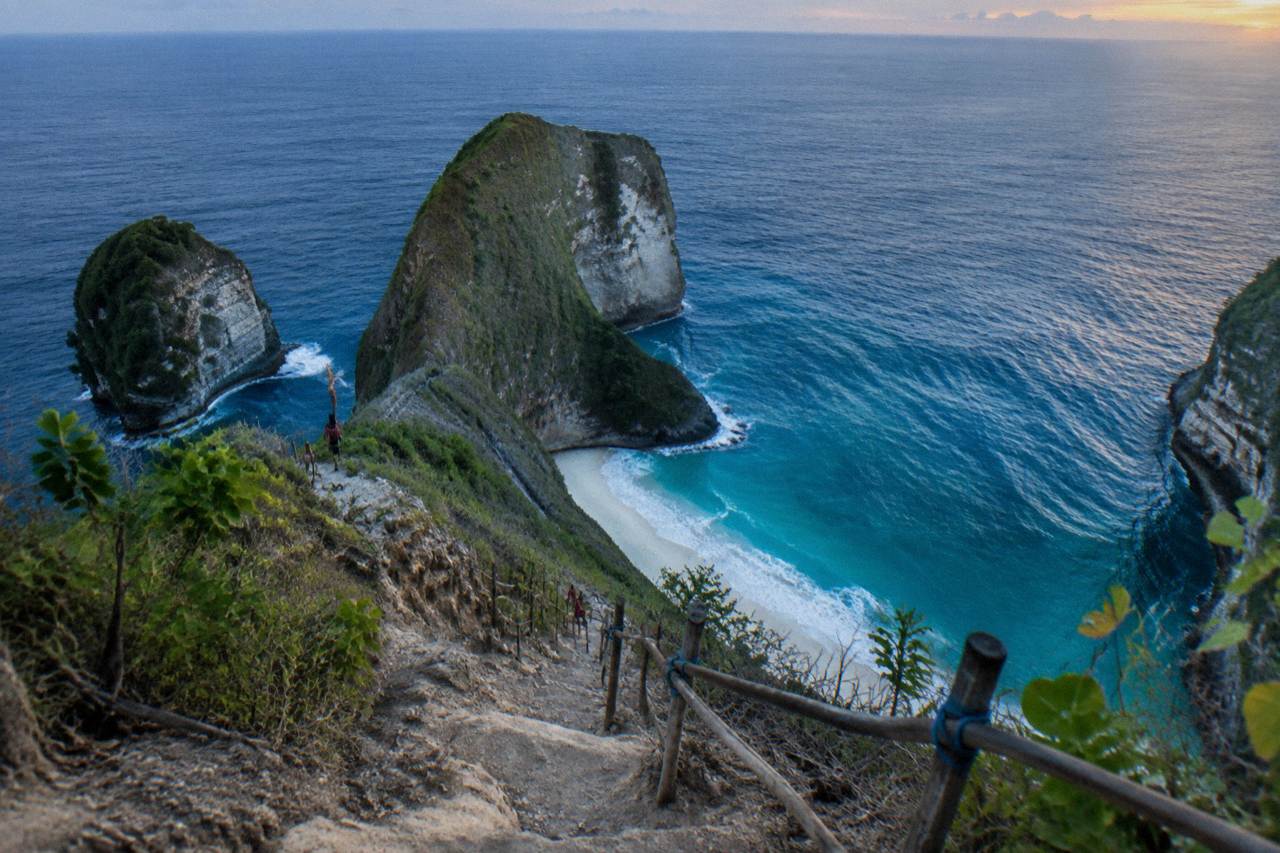
Reaching Kelingking Beach requires a steep on-foot descent of about 20 minutes down a rocky trail with a low bamboo handrail. The climb back up takes far longer. A glass lift project started in 2024 but was halted in October 2025 and remains unfinished. Swimming is banned, and the beach is only accessible by foot.
Kelingking Beach is the most photographed spot on Nusa Penida and a highlight of many Nusa Penida Tours itineraries. The dramatic T-Rex-shaped cliff and turquoise bay draw thousands of visitors each month. Most people stop at the viewpoint, snap a photo, and move on. A smaller number attempt the trail down to the sand. The descent is steep, unshaded, and entirely on foot, and the glass lift that was supposed to replace it never opened. This guide explains exactly what the path is like, why the elevator project stalled, what you need to wear, who should skip the climb, and how to combine a Kelingking visit with a west coast day tour that makes the logistics straightforward.
How Do You Get Down To Kelingking Beach?
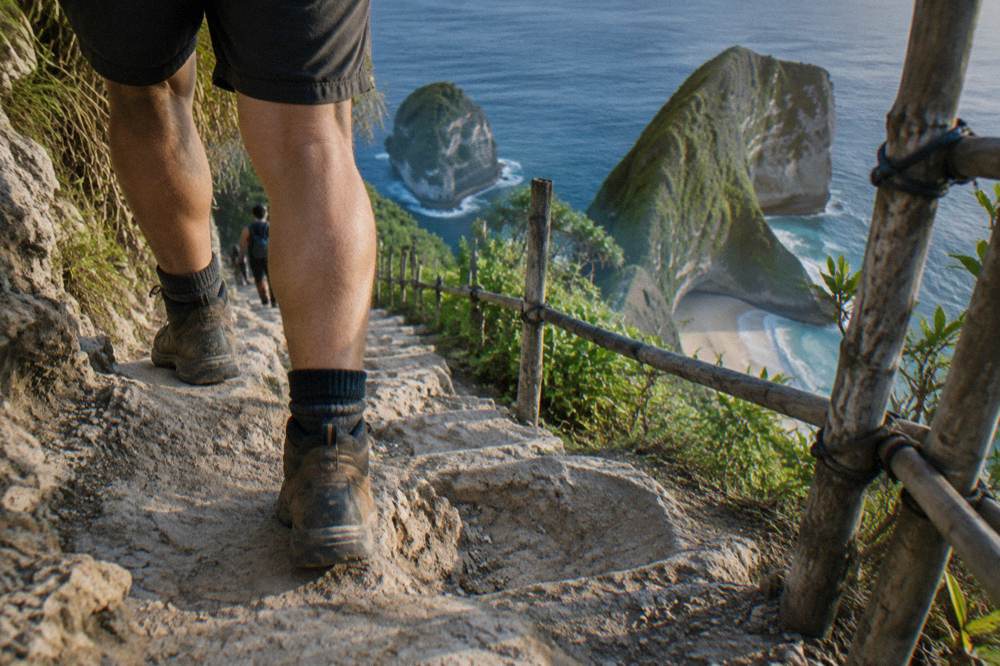
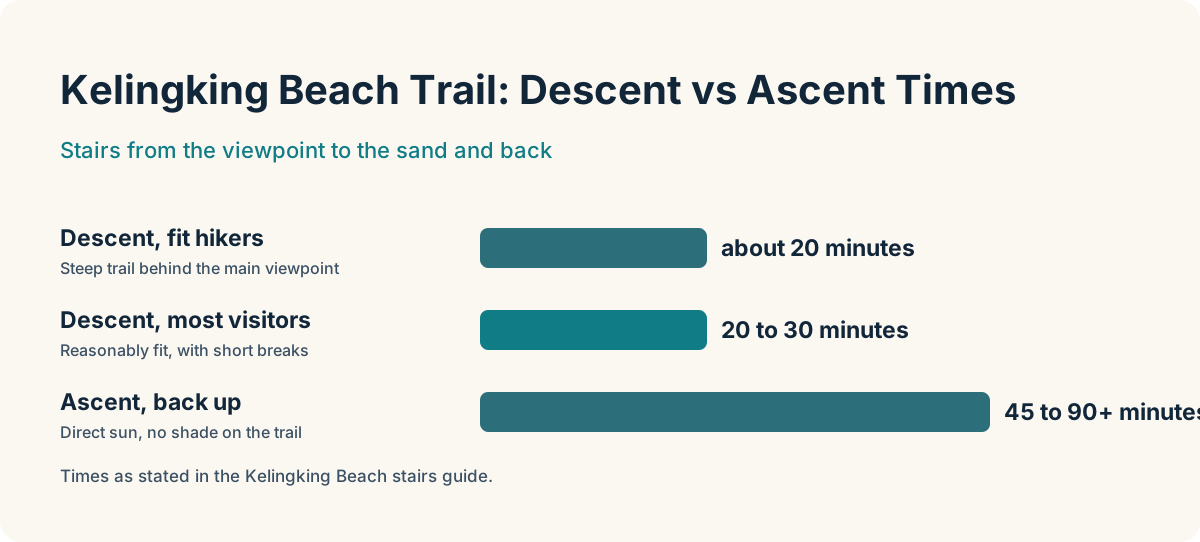
The only way down to Kelingking Beach is on foot via a steep trail that starts at the viewpoint. The descent takes about 20 minutes for fit hikers, but the return climb can take 45 to 90 minutes or more. The path includes built steps at the top, then transitions to rock and dirt with a low bamboo handrail in places.
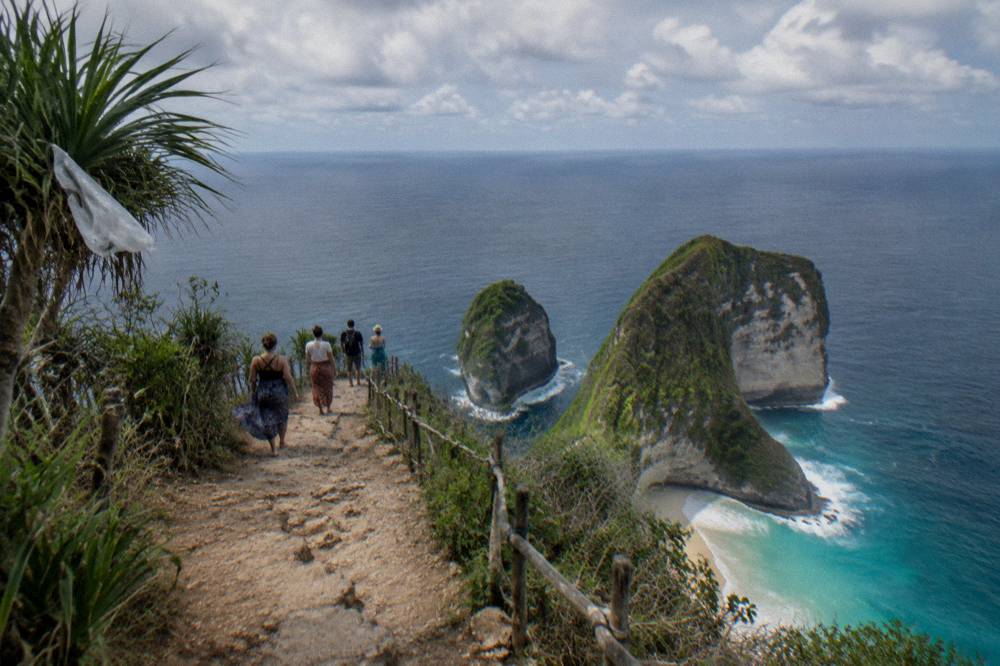
The trail begins just behind the viewpoint area, where a set of concrete steps leads down through the vegetation. After the first few dozen steps, the surface changes to packed earth, loose gravel, and exposed rock. A low bamboo handrail runs along parts of the route, but it is not continuous, and in some sections it is more of a visual guide than a reliable support. The path is narrow, often only wide enough for one person, and you will need to step aside to let others pass on the way up.
The descent is steep, and the tropical heat makes it feel harder than it looks from the top. Most people reach the sand in 20 to 30 minutes if they are reasonably fit and take short breaks. The climb back up is far more demanding. The same steep gradient works against you, and the lack of shade means you are climbing in direct sun for most of the way. Reports from recent visitors put the ascent time anywhere from 45 minutes to over 90 minutes, depending on fitness and how often you stop.
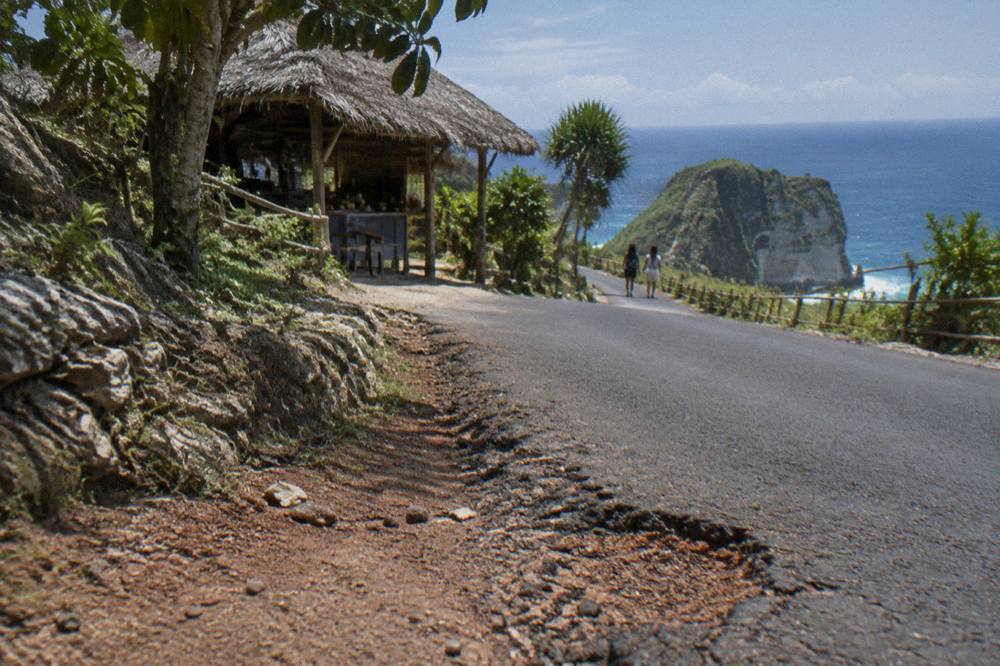
The access road to the Kelingking parking area was upgraded in mid-2026, with a 2-kilometer hotmix asphalt project that started in July. The main road is now in good condition, though the final approach still has some potholes. Once you park, a short walk brings you to the viewpoint and the start of the trail.
| Trail detail | What to expect |
|---|---|
| Start point | Behind the main Kelingking viewpoint |
| Descent time | About 20 minutes down |
| Ascent time | 45 to 90+ minutes up |
| Surface | Concrete steps at top, then rock, dirt, and gravel |
| Handrail | Low bamboo rail, not continuous |
| Shade | None on the trail itself |
| Difficulty | Strenuous, steep, exposed |
The trail is not maintained to any formal standard, and conditions can change after heavy rain. Loose rock and eroded sections are common. The island's dry season (April to October) offers the most reliable footing, while the wet months (November to March) can make the path slippery and more hazardous. If you plan to attempt the descent, a morning start is best, before the midday heat peaks and the trail gets crowded.
What Happened To The Kelingking Beach Glass Lift?
A glass elevator project began construction in 2024 but was halted by Bali authorities in October 2025 over planning, environmental, and safety violations. An investor won an administrative court case in September 2026, but the provincial government is appealing, and no work has restarted. The unfinished structure remains, and the beach is still only reachable on foot.
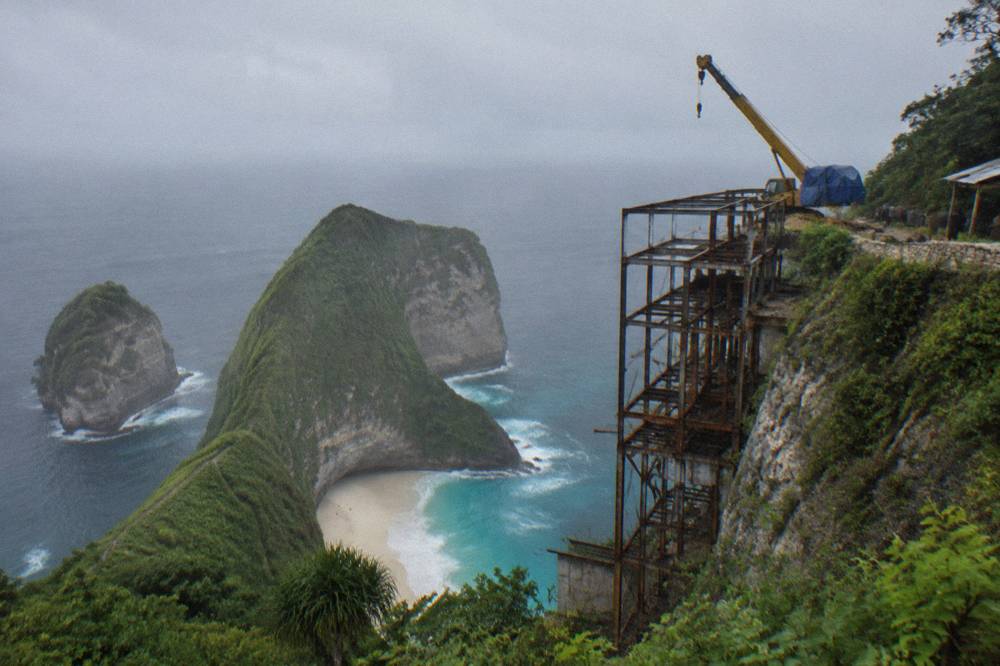
The idea of a glass lift at Kelingking Beach captured headlines and social media for months. The project promised to carry visitors from the clifftop down to the beach in minutes, removing the need for the strenuous hike. Construction started in 2024, and a large metal frame and crane appeared on the cliffside. Then, on October 31, 2025, the Bali provincial government ordered work to stop. The authorities cited breaches of planning permits, environmental regulations, and safety standards, and a demolition order followed in November 2025.
The investor, PT Indonesia Kaishi, challenged the stop-work order in the Denpasar Administrative Court. On September 3, 2026, the court ruled in the investor's favor, declaring the halt and demolition order invalid (decision number 17/G/2026/PTUN.DPS). However, the provincial government immediately filed an appeal. As of October 2026, no construction has resumed. The unfinished lift structure and crane remain in place, but there is no opening date, no ticket price, and no indication of when, or if, the project will be completed.
For now, and for the foreseeable future, the only way to reach Kelingking Beach is on foot. The lift is not operational, and visitors should not expect it to be available during their trip. The legal process could take months or years, and even a final court ruling would not guarantee that construction restarts quickly.
The halted lift has not stopped visitors from enjoying the viewpoint, which remains open and free to access. Parking costs IDR 5,000 for a scooter and IDR 10,000 for a car. The viewpoint itself is a short, flat walk from the parking area and offers the iconic T-Rex-shaped cliff photo without any hiking. For those who want to combine the Kelingking viewpoint with other west coast stops, a guided day tour is the simplest option.
Is Swimming Allowed At Kelingking Beach?
Swimming at Kelingking Beach has been officially banned since February 2023 due to dangerous currents, strong shore break, and the absence of lifeguards. The ban is strictly enforced, and several drownings occurred before it was implemented. Visitors can only enjoy the beach from the sand, not the water.
The turquoise water looks inviting from the clifftop, but the conditions at Kelingking are deceptive. The beach faces the open Indian Ocean, and powerful waves break directly onto the steep shore. Rip currents are strong and unpredictable, and there is no lifeguard service. Before the ban, multiple drownings were recorded. The February 2023 prohibition applies year-round and is not seasonal.
Signs at the top of the trail warn against entering the water, and local guides and drivers reinforce the message. Even wading in the shallows is dangerous, as a sudden wave can knock a person off their feet and drag them into deeper water. The ban is not a suggestion, it is a hard rule, and ignoring it puts lives at risk.
If you want to swim during your Nusa Penida visit, Crystal Bay and Gamat Bay on the west coast are far safer alternatives. Both are sheltered, have much calmer conditions, and are included on many west coast snorkeling tours. Crystal Bay offers 20 to 30 meters of visibility and is known for its turtles and coral, while Gamat Bay is quieter and suitable year-round.
What Should You Wear For The Kelingking Beach Descent?
Sturdy closed-toe shoes with good grip are essential for the rocky, uneven trail. Lightweight, breathable clothing, a hat, sunscreen, and at least one liter of water per person are recommended. Flip-flops and sandals are unsafe on the steep sections and loose gravel.
The trail surface is a mix of concrete, compacted earth, loose rock, and gravel, and it becomes slippery after rain. Shoes with a proper tread, such as hiking sandals with a heel strap or lightweight trail runners, are the minimum. Many visitors attempt the descent in flip-flops and regret it within the first few minutes. The climb back up puts extra strain on your feet and ankles, and a twisted ankle on the trail means a difficult, slow extraction.
Clothing should be light and breathable, as the heat and humidity are intense, especially between 11 a.m. and 3 p.m. A wide-brimmed hat and sunglasses help with the direct sun, and sunscreen is a must, there is no shade on the trail itself. Carry at least one liter of water per person, and consider a small snack for energy on the way back up. There are no vendors on the beach or along the trail, so everything you need must come down with you.
A small backpack is the most practical way to carry your gear, leaving both hands free for the handrail and for balance on the steeper sections. Avoid bringing valuables or heavy camera equipment unless it is securely strapped. The beach itself has no facilities, no toilets, no shade, and no food stalls, so plan accordingly.
A guided west coast tour can simplify the logistics. The One Day Nusa Penida Island West tour includes hotel transfers, a private car, and a local driver who knows the best times to visit the viewpoint and can advise on trail conditions. You can leave extra gear in the vehicle and focus on the hike.
Who Should Skip The Kelingking Beach Climb?
The climb is not suitable for anyone with knee, hip, or heart conditions, or for those who are not reasonably fit. The steep ascent in tropical heat can be exhausting, and there is no shade on the trail. Elderly visitors, young children, and anyone with mobility issues should enjoy the viewpoint from the top instead.
The descent is often described as the easy part, but the climb back up is a serious physical challenge. The gradient is relentless, the heat saps energy quickly, and there are no rest stops with shade or seating. People who regularly hike or exercise may find it tough but manageable. Those who are sedentary, carrying extra weight, or unaccustomed to tropical humidity will struggle.
Knee and hip problems are a particular concern because the descent puts heavy impact on joints, and the ascent requires repeated high steps on uneven ground. The low bamboo handrail offers minimal support, and in many places it is too low to be useful for pulling yourself up. If you have any doubt about your fitness or joint health, the viewpoint is a far better choice. The iconic photo of the T-Rex-shaped cliff is taken from the top, not the beach, so you do not miss the main attraction by staying at the clifftop.
Young children should not attempt the trail. The drop-offs are steep, the path is narrow, and a tired child on the way back up is a real safety risk. There are no barriers or railings in many sections, and a slip could have serious consequences. Parents with young kids are better off enjoying the viewpoint and then heading to a safer beach like Crystal Bay for a swim.
For visitors who want to see Kelingking without the physical demands of the hike, a private car hire with a driver is a flexible alternative. A Nusa Penida Private Car Hire with Driver lets you set your own pace, stop at the viewpoint for as long as you like, and then continue to other west coast spots without rushing.
| Fitness level | Recommendation |
|---|---|
| Regular hiker or gym-goer | Manageable with breaks; allow extra time for ascent |
| Moderate fitness, occasional exercise | Challenging; start early, carry plenty of water |
| Sedentary or unaccustomed to heat | Skip the descent; enjoy the viewpoint from the top |
| Knee, hip, or heart condition | Do not attempt; the trail is steep and uneven |
| Children under 10 | Not recommended; steep drops and no barriers |
| Elderly or mobility-impaired | Viewpoint only; the trail is not accessible |
How To Visit Kelingking Beach On A West Nusa Penida Day Tour
Most west coast day tours include a stop at the Kelingking viewpoint, and some allow time for the descent. Tours typically combine Kelingking with Broken Beach, Angel's Billabong, and Crystal Bay. A guided tour handles transport, entrance fees, and timing, leaving you free to decide whether to hike down.
The west coast of Nusa Penida packs several iconic stops into a relatively compact area. Kelingking is the most famous, but Broken Beach and Angel's Billabong are only 20 to 30 minutes away by car, and Crystal Bay is another short drive. A full-day west tour usually starts with a fast boat from Sanur, arriving at Toyapakeh or Banjar Nyuh harbor by mid-morning. From there, a private car with a local driver takes you to each stop in a logical loop.
The drive from the harbor to Kelingking takes 30 to 60 minutes, depending on which port you arrive at and the traffic on the day. Most tours spend 45 minutes to an hour at the Kelingking viewpoint. If you want to attempt the descent, you need to tell your driver in advance so they can plan the timing. The hike down and back takes at least 90 minutes for most people, and that cuts into time at the other stops. Some tours offer a longer stay at Kelingking if you book a private itinerary, while shared group tours typically stick to the viewpoint only.
| West coast stop | Distance from Kelingking | Typical visit time |
|---|---|---|
| Kelingking Beach viewpoint | - | 45 to 90+ minutes |
| Broken Beach | 20 to 30 minutes | 30 to 45 minutes |
| Angel's Billabong | Same parking as Broken Beach | 20 to 30 minutes |
| Crystal Bay | 30 to 40 minutes | 1 to 2 hours (swimming and snorkeling) |
A west coast day tour that includes snorkeling adds a stop at Crystal Bay or Gamat Bay, where you can swim and see coral and turtles. The One Day Nusa Penida Island West with Snorkeling combines the land sights with a snorkeling session, and the operator provides all the gear. If you prefer a fully private experience, the West Nusa Penida Kelingking Broken Beach Private Guided Tour gives you a dedicated driver and guide for the day, with the flexibility to spend more time at the stops that interest you most.
For a premium option, an all-inclusive day trip like the Nusa Penida All-Inclusive Day Trip bundles fast boat tickets, a private car, lunch, and all entrance fees into one package. This takes the planning off your plate and gives you the freedom to decide at the viewpoint whether you want to hike down or simply enjoy the view.
Kelingking Beach Safety And Recent Incidents
Kelingking Beach has a history of serious incidents, including a fatal cliff fall in September 2026. The trail itself is not inherently dangerous if you stay on the marked path, wear proper shoes, and avoid the edges. The main risks are heat exhaustion, slips on loose rock, and the temptation to leave the trail for a better photo.
In September 2026, a visitor died after falling from the cliff near the viewpoint. The person had left the marked path, and the fall was estimated at 80 to 180 meters. Recovery of the body took a joint team over an hour using the steep stairs. This incident, along with earlier drownings before the swimming ban, underscores the importance of staying on the designated trail and respecting the safety rules.
The trail itself has no barriers at the edges, and the drop-offs are sheer in places. The low bamboo handrail is not a guardrail, it is a guide. Do not lean on it or use it to support your full weight. Keep to the center of the path, and never step off the trail to get a better angle for a photo. The cliff edges are unstable, and a slip can be fatal.
Heat exhaustion is another real risk. The combination of high temperatures, humidity, and physical exertion can lead to dehydration and heatstroke. Symptoms include dizziness, nausea, and confusion. If you start to feel unwell on the trail, stop in whatever shade you can find, drink water, and turn back if necessary. There is no shame in aborting the descent, the beach will still be there another day.
| Safety rule | Why it matters |
|---|---|
| Stay on the marked trail | Cliff edges are unstable and unguarded |
| Wear sturdy shoes | Loose rock and gravel cause slips |
| Carry at least 1 liter of water | No water sources on the trail or beach |
| Do not swim | Strong currents and shore break; ban in place since Feb 2023 |
| Start early in the morning | Avoid midday heat and afternoon crowds |
| Turn back if you feel unwell | Heat exhaustion can escalate quickly |
Common Questions About Kelingking Beach Access
Is The Kelingking Beach Glass Lift Open?
No. The glass lift project was halted in October 2025, and although an investor won a court case in September 2026, the provincial government is appealing. No construction has resumed, and there is no opening date. The only access is on foot.
How Long Does It Take To Climb Down And Back Up?
The descent takes about 20 minutes for fit hikers. The ascent takes 45 to 90 minutes or more, depending on fitness, heat, and how often you stop. The trail is steep and unshaded, so the climb back up is significantly harder than the way down.
Can You Swim At Kelingking Beach?
No. Swimming has been banned since February 2023 due to dangerous currents and strong shore break. The ban is strictly enforced, and there are no lifeguards. Safer swimming alternatives include Crystal Bay and Gamat Bay on the west coast.
What Shoes Should I Wear For The Kelingking Trail?
Sturdy closed-toe shoes with good grip are essential. Hiking sandals with a heel strap or trail runners work well. Flip-flops and sandals are unsafe on the steep, rocky sections. The trail surface includes loose gravel and exposed rock.
Is The Kelingking Viewpoint Worth It If I Do Not Hike Down?
Yes. The iconic T-Rex-shaped cliff photo is taken from the viewpoint at the top, not from the beach. You can enjoy the famous view, take photos, and then continue to other west coast stops without the strenuous hike.
Can I Visit Kelingking Beach On A Day Trip From Bali?
Yes. Most west coast day tours from Bali include Kelingking as a stop. You take a fast boat from Sanur in the morning, visit the viewpoint and other west coast sights, and return to Bali by late afternoon. A guided tour handles all the logistics.