Kelingking Beach: The T-Rex Cliff Of Nusa Penida
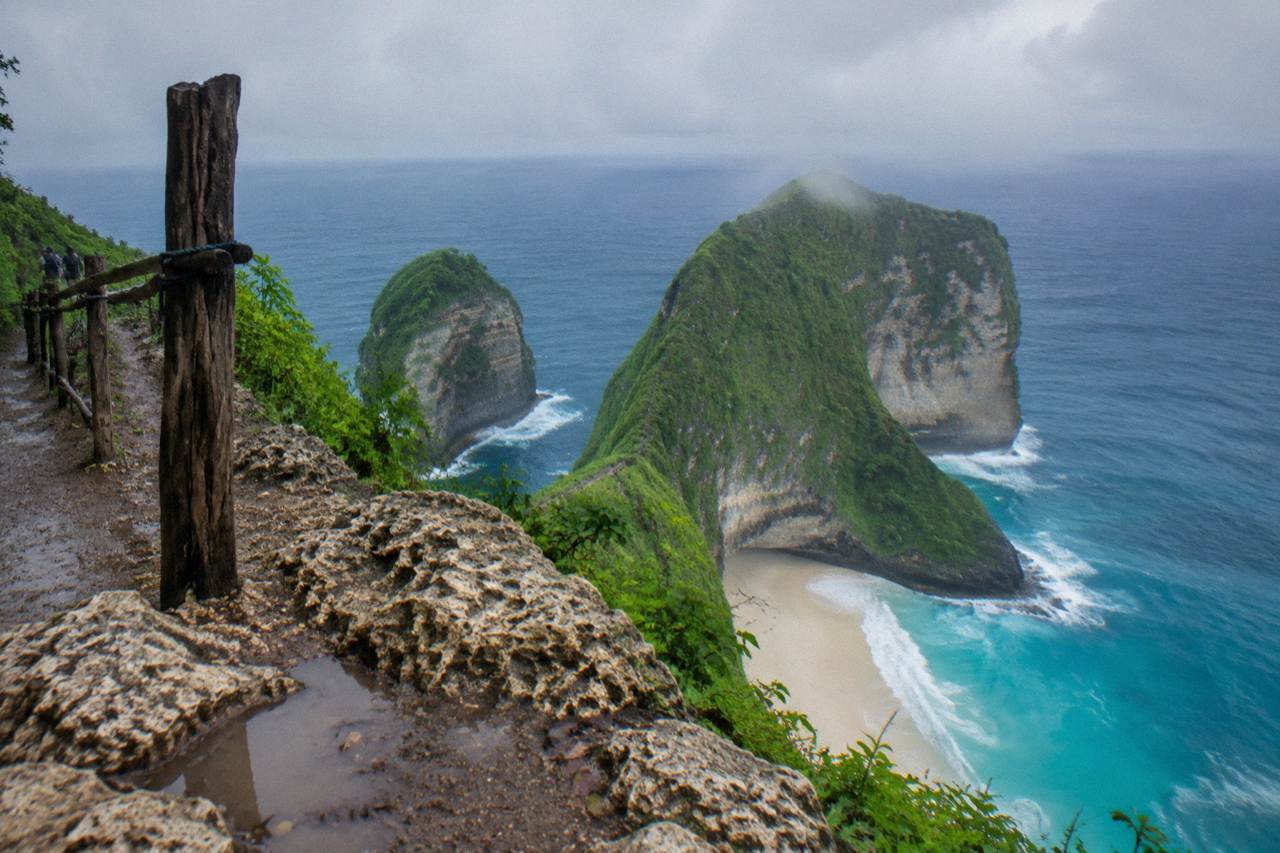
Kelingking Beach is the cliff on every Nusa Penida postcard: a limestone headland that looks like a Tyrannosaurus rex, a thin ribbon of white sand far below, and water the colour of pool glass. This page covers what it is, how to reach it, what the descent actually involves, and how the west tours schedule it.
Short answer
Kelingking Beach is a viewpoint and a steep cliff descent on Nusa Penida's west coast, about 30 to 60 minutes by road from the harbour. Entry is free; you pay only parking, about IDR 5,000 for a scooter and IDR 10,000 for a car, plus the island retribution of IDR 25,000 per adult. Swimming has been banned since February 2023.
Kelingking Beach is the single most photographed stretch of coast on Nusa Penida, and arguably in all of Bali. The cliff does the work: a jagged limestone promontory that, from the main viewpoint, reads unmistakably as a Tyrannosaurus rex head, with a pale sand cove tucked 200 metres beneath it and the Indian Ocean running an impossible gradient from aqua to navy. Almost every west coast tour on this roster stops here, and most group it with Broken Beach and Angel's Billabong in a single loop. This guide covers the viewpoint, the access logistics, the fees, the swim ban, and how the tours actually schedule the stop, with the full descent logistics covered separately in the Kelingking stairs and lift guide.
What Is Kelingking Beach And Why Is It Famous?
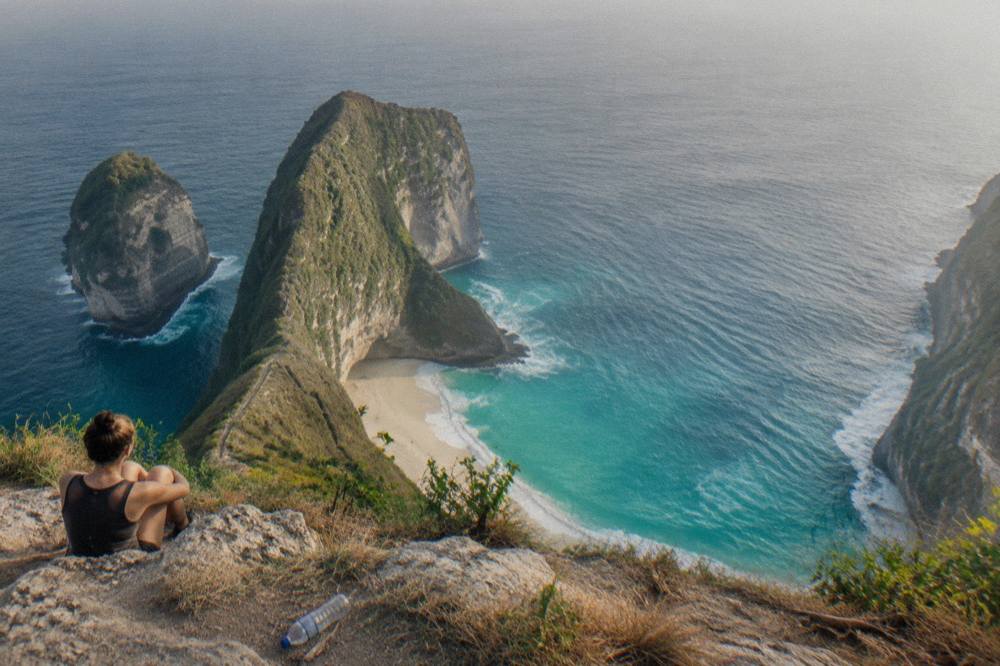
Kelingking Beach is a cliffside viewpoint and a steep trail on Nusa Penida's southwest coast, about 30 to 60 minutes by road from the main harbour at Toyapakeh. There is no entrance fee, only parking, and the famous T-Rex shape is the headland itself, best read from the main platform above the trailhead. The beach below is real but hard to reach, and swimming there is banned.
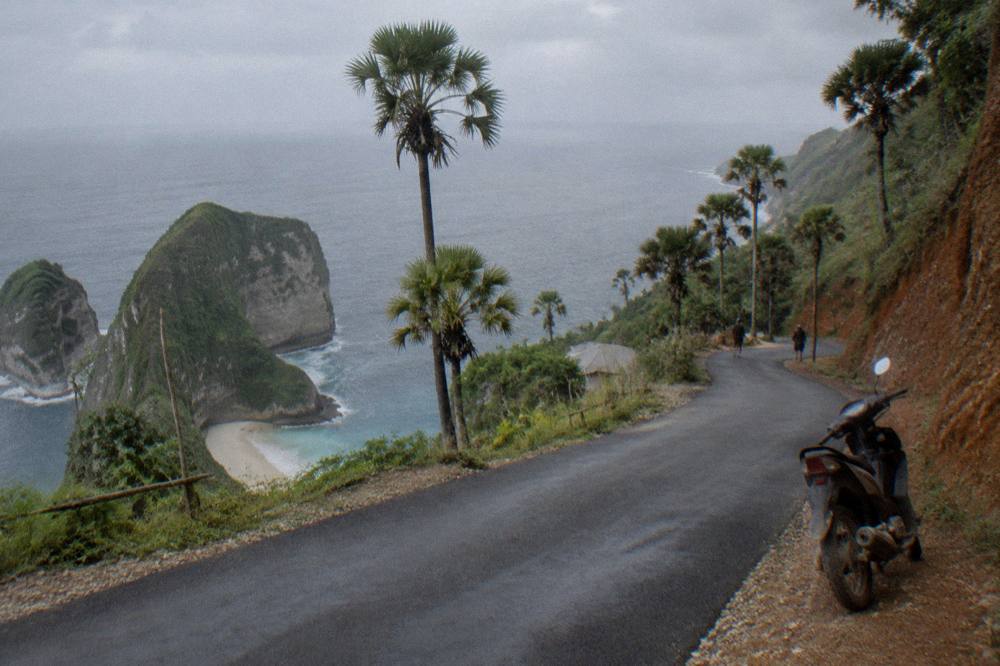
The fame is almost entirely photographic. The headland, seen from the cliff top, forms the silhouette of a Tyrannosaurus rex: the snout, the eye, the neck. Photographers found it in the late 2010s, drone shots went viral, and within a few years the viewpoint became the single busiest spot on an island of about 200 square kilometres with no public transport. The local guide page for Kelingking records the practical basics: access on foot only, a steep descent, and a swimming ban in force since February 2023.
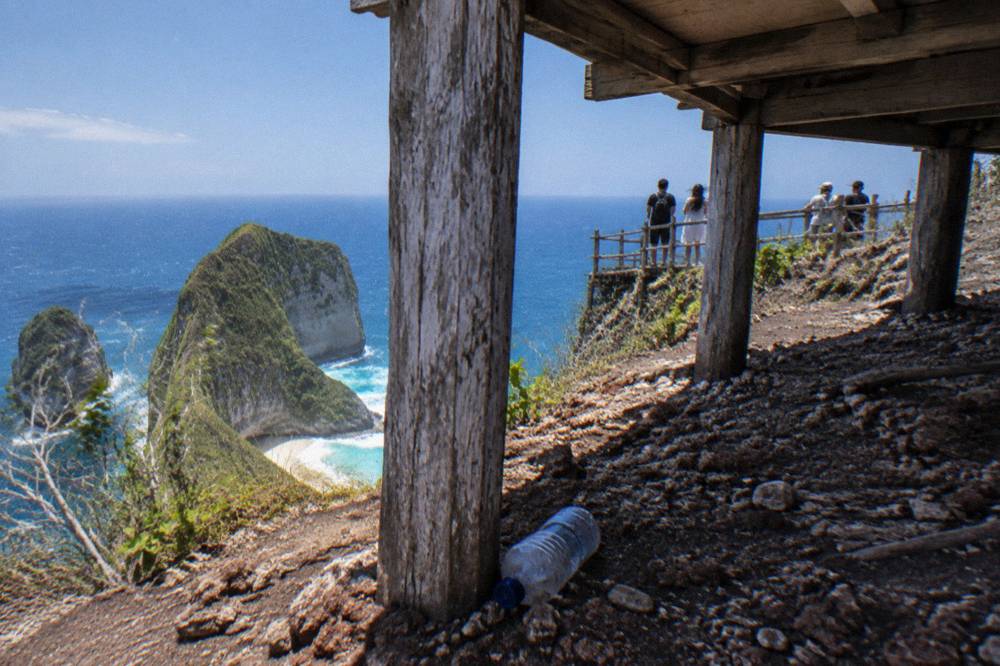
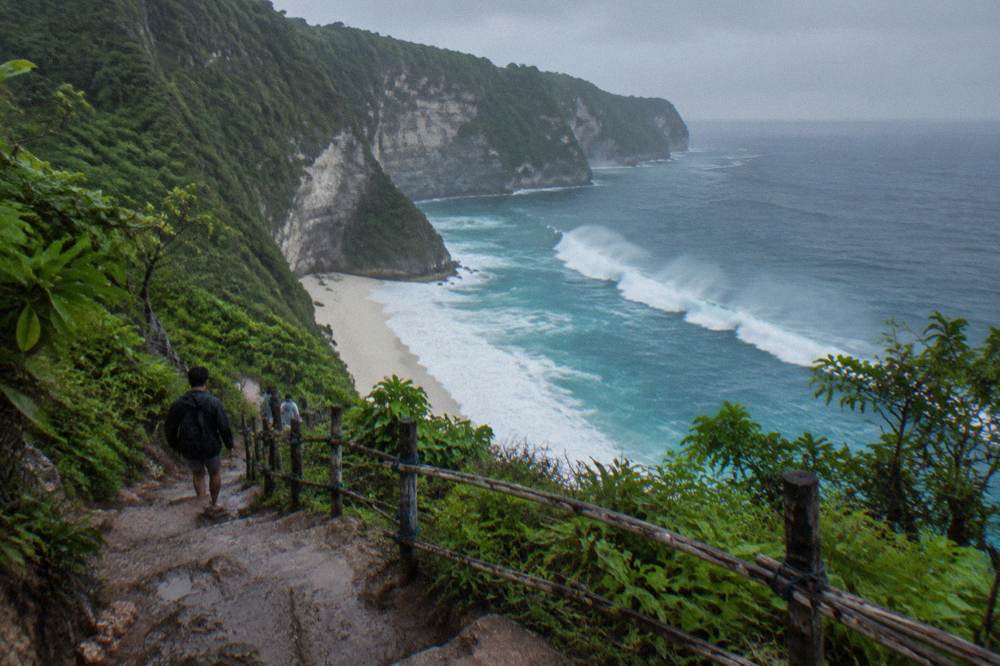
Two things are worth separating before you plan anything. The viewpoint is easy: a flat walk from the parking area to a wooden platform and a fence line, doable in any footwear, with the postcard shot available within minutes of arriving. The descent to the beach is a different activity entirely, a steep, exposed trail with loose rock and crude railings that takes most people well under an hour down and considerably longer back up. The Nusa Penida Tours roster reflects that split: every west coast tour stops at the viewpoint, while only visitors with spare time and steady legs attempt the beach itself.
The cliff also carries a genuinely unusual piece of infrastructure history: a half-built glass lift on the cliff face, halted by the provincial government in October 2025, still standing, still unfinished. That story is covered in full further down this page.
How Do You Get To Kelingking Beach From Bali Or The Harbour?
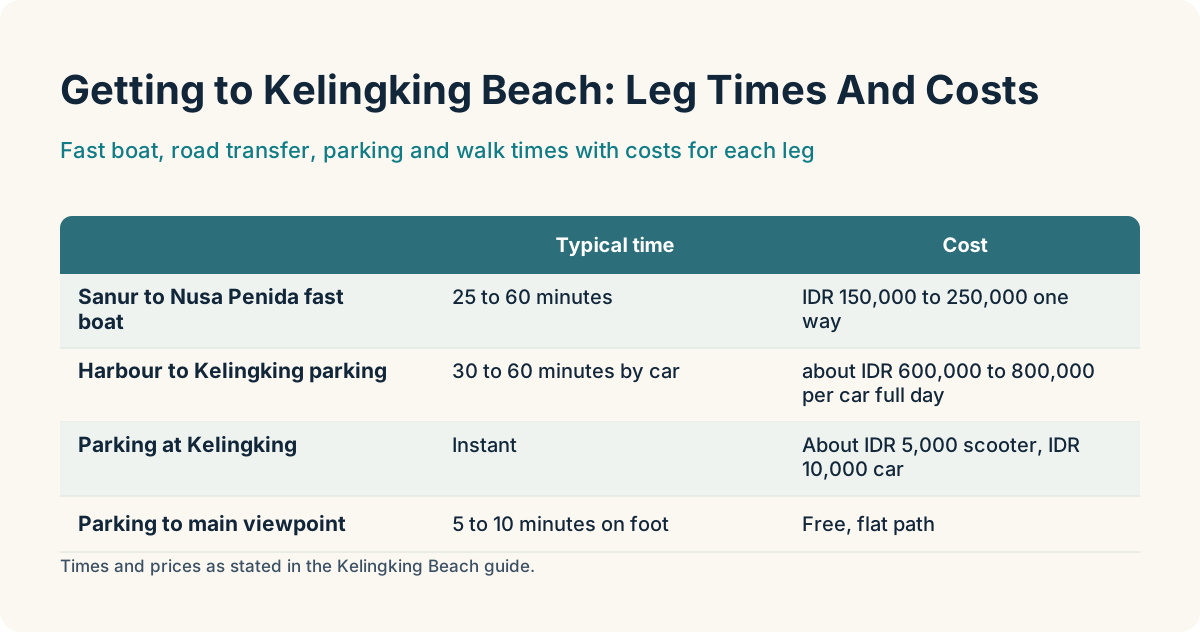
From Bali, you take a fast boat from Sanur to Nusa Penida, a crossing of roughly 25 to 60 minutes depending on the operator and the sea, then a vehicle for 30 to 60 minutes to the Kelingking parking area. There is no public transport on the island, so the vehicle leg means a tour, a private driver, or a scooter. Parking at Kelingking costs about IDR 5,000 for a scooter and IDR 10,000 for a car.
The boat leg is the fixed part. Sanur is the main departure point, with more than 20 departures daily across operators, the first around 06:30 to 07:30 and the last around 17:00, and one-way fares in the range of IDR 150,000 to 250,000. The crossing itself is short; what varies is the road leg on the far side. From the Toyapakeh and Banjar Nyuh harbour area, Kelingking is about 30 to 60 minutes by car depending on traffic and the exact road, and the island's roads, while mostly asphalted now, are steep and narrow in places.
| Leg | Typical time | Cost notes |
|---|---|---|
| Sanur to Nusa Penida fast boat | 25 to 60 minutes | IDR 150,000 to 250,000 one way |
| Harbour to Kelingking parking | 30 to 60 minutes by car | Included on tours; private driver about IDR 600,000 to 800,000 per car full day |
| Parking at Kelingking | Instant | About IDR 5,000 scooter, IDR 10,000 car |
| Parking to main viewpoint | 5 to 10 minutes on foot | Free, flat path |
Three practical routes cover the vehicle leg. A booked west tour handles everything, boat included on most options: the One Day Nusa Penida Island West tour from Smile Nusa Penida runs about 8 hours from $35.5 per person with a 4.7 rating from 197 reviews, and bundles the fast boat, a private air-conditioned car, a driver-guide and entrance tickets. A private car with driver, at from $27 per person on the Trip Gotik listing with a 4.8 rating from 2,740 reviews, suits travellers who want to set their own pace and linger past the tour-bus window. Renting a scooter is the third option, and the one this site treats with caution: the side roads are hilly, and the scooter rental and road safety guide covers the honest case for a driver instead.
If you are weighing the full-day options, the east-plus-west alternative is the Trip Gotik East and West Highlights tour, from $33 per person with a 4.7 rating from 8,370 reviews, which compresses both coasts into 8 to 10 hours. It reaches Kelingking, but with less time at it than a west-only day, which is the trade-off to understand before booking.
How Do The West Tours Schedule The Kelingking Stop?
Most west coast tours reach Kelingking between mid-morning and early afternoon, after the boat crossing and the drive, and give the stop roughly 30 to 60 minutes, enough for the viewpoint and photos but not for the descent to the beach. Private tours are looser. If the beach itself is your goal, a private format or a self-driven day is the realistic way to get the time the trail needs.
The group pattern is consistent across the roster. Boats leave Sanur early, the island leg starts by mid-morning, and Kelingking usually lands first or second on the itinerary, ahead of Broken Beach and Angel's Billabong, which sit about 20 to 30 minutes and 40 minutes further along the coast. That sequencing is sensible: Kelingking's parking area is the most congested on the island, and tours front-load it before the midday buildup. The trade-off is time. A 30 to 60 minute stop covers the platform, the fence line and the drone-free phone shot comfortably. It does not cover a descent that takes most people 30 to 45 minutes down and 45 to 90 minutes back up, in heat, on loose rock.
The private formats solve that. The West Nusa Penida Kelingking Broken Beach Private Guided Tour, from $39.51 per person with a 4.7 rating from 57 reviews, runs 9 to 10 hours with a guide-driver and lunch at a local restaurant, and a private guide will hold the Kelingking stop open as long as the group wants. The all-inclusive Trip Gotik transfers tour, from $42 per person with a 4.6 rating from 2,310 reviews, adds hotel pickup across south Bali and the round-trip boat, which removes the two logistics most likely to go wrong on a self-planned day.
For snorkelers, the west tours with a water component split the day differently. The One Day Nusa Penida Island West with Snorkeling tour, from $66.96 with a 4.5 rating from 597 reviews, pairs the Kelingking viewpoint stop with snorkeling at Crystal Bay, which is the sheltered west-coast water spot. It is the format to pick when one day has to carry both the cliff and the reef.
Viewpoint Or Descent: Which Kelingking Experience Is Right For You?
The viewpoint is a short, flat, safe walk with the iconic shot, and it is all most visitors need. The descent is a steep, exposed trail with loose rock and crude railings, about 20 minutes down and far longer back up, and it should only be attempted in good footwear with time and water to spare. The full logistics live in the dedicated stairs guide.
This is the decision that shapes the day, and it deserves a straight comparison rather than a shrug. The viewpoint costs nothing in effort and delivers the image that made the island famous. The descent delivers a near-empty white sand beach at the bottom, a genuine walk, and a climb back that honest accounts describe as the hardest 45 to 90 plus minutes of a Bali trip. The Kelingking stairs and lift guide covers the trail in full: the built steps at the top, the rock and bamboo handrail below, timing, footwear, and who should not attempt it.
| Factor | Viewpoint only | Viewpoint plus descent |
|---|---|---|
| Time needed | 15 to 60 minutes | 2 to 3 hours round trip |
| Footwear | Anything sturdy | Closed shoes with grip |
| Fitness required | Minimal | High; ascent is steep and hot |
| What you get | The T-Rex shot, the fence line, the panorama | The beach itself, near-empty sand, the cliff from below |
| Main risk | Crowds at the platform | Loose rock, heat, exposure, no lifeguards |
One point this site will not soften: the trail is not a maintained staircase the whole way, and people have died after leaving the marked path. The September 2026 cliff fall, reported by the safety reporting on the cliff and the halted lift, involved a visitor off the marked route. Stay on the trail, turn back if the light is going, and treat the ascent estimate as a floor, not a ceiling.
Why Is Swimming Banned At Kelingking Beach?
Swimming at Kelingking Beach has been officially banned since February 2023 because of dangerous currents, a heavy shore break and the absence of lifeguards. The ban is enforced by signage at the trailhead and the beach, and it exists because the cove's shape funnels ocean swell into a shore break that overpowers strong swimmers. The beach is for standing and looking, not for the water.
The cove looks gentle from 200 metres up, which is exactly the problem. The same cliff that photographs so well faces open Indian Ocean swell, and the steep beach profile means waves dump rather than spill. Drownings were recorded at the cove before the ban, and the February 2023 prohibition followed. The guide record for the beach states the ban plainly, and no tour on this roster will take guests into the water here.
If the water is the point of your day, the west coast has a sanctioned answer in Crystal Bay, the sheltered swimming and snorkeling spot about 40 minutes onward, with reported visibility of 20 to 30 metres and its calmest stretch from April to September. The Crystal Bay guide covers it in full, and the west tours with snorkeling, from $66.96 on the Smile Nusa Penida listing, pair the Kelingking viewpoint with a Crystal Bay water stop by design.
What Does A Visit To Kelingking Actually Cost?
Entry to Kelingking Beach itself is free; the verified costs are parking at about IDR 5,000 per scooter and IDR 10,000 per car, plus the Nusa Penida island retribution of IDR 25,000 per adult and IDR 15,000 per child aged 4 to 13, paid once and scanned at the harbour. Foreign visitors also owe the separate Bali tourist levy of IDR 150,000 per trip.
The fee structure has two layers that travellers routinely confuse, so here is the clean version. The island retribution is a Nusa Penida charge, paid online or at counters with a QR voucher scanned at the harbour, and one voucher covers a single entry including Kelingking, Broken Beach and Angel's Billabong the same day with no re-payment. The official retribution portal states the amounts and the single-voucher rule. The Bali tourist levy is separate, IDR 150,000 per person once per trip, paid through the official Love Bali system before or on arrival in Bali; it is not a Nusa Penida fee and does not cover anything on the island. The entrance fees and Bali levy guide carries the full breakdown.
| Item | Amount | Notes |
|---|---|---|
| Kelingking entry | Free | No ticket office at the site |
| Parking | About IDR 5,000 scooter, IDR 10,000 car | Collected at the parking area |
| Island retribution, adult | IDR 25,000 | QR voucher, scanned at the harbour |
| Island retribution, child 4 to 13 | IDR 15,000 | Infants free |
| Bali tourist levy | IDR 150,000 per person per trip | Paid via the official Love Bali system |
| Tour coverage | Varies by listing | Many west tours include entrance fees in the price |
The tour angle matters here. Several listings on the roster include entrance fees in the headline price, the One Day Nusa Penida Island West tour among them, which simplifies the day but does not remove the harbour retribution or the Bali levy; those are island and province charges, not attraction tickets. Check what your tour price includes before assuming the listed figure is the whole cost.
When Is The Best Time To Visit For Light And Crowds?
The best light on the T-Rex cliff falls from late morning through the afternoon, when the sun moves over the headland, and the thinnest crowds are early morning, roughly the first hour after the parking area opens, or late afternoon after the tour groups leave. July and August bring peak crowds; April to October brings the calmest, driest weather, with August averaging just 35 mm of rain.
Crowd timing and light timing pull in opposite directions, and the honest advice is to pick which one you care about. The early visit wins on people: the first boats from Sanur land mid-morning, so the platform before about 10:00 belongs to island-based visitors and overnight guests, and it is the quiet version of the viewpoint. The afternoon wins on light: the headland faces west-southwest, and by mid to late afternoon the sun is behind the photographer, the cliff face is fully lit, and the water colour saturates. Midday is the worst of both, hot, harsh and busiest, and that is precisely when most group tours arrive.
| Period | Rainfall (mm, rainy days) | What it means for Kelingking |
|---|---|---|
| January | 288 (20) | Wet, slippery trail, low visibility days |
| April | 123 (12) | Shoulder season, thinner crowds |
| July | 43 (3) | Peak crowds, prime dry weather |
| August | 35 (1) | Driest month, busiest platform |
| September | 47 (1) | Dry, crowds easing after the peak |
| December | 254 (16) | Wet season, rough sea, quiet viewpoint |
The seasonal picture is consistent across the island's data: the dry season from April to October delivers the calm seas and 15 to 30 metre visibility that also make the west coast snorkeling reliable, while November to March brings swell, rain and a higher chance that a boat or a snorkel stop is rerouted. The weather and best time guide carries the month-by-month detail, including sea temperatures that dip to about 26.2C in August.
What Is The Story With The Halted Glass Lift?
A glass cliff lift at Kelingking, begun in 2024, was halted by the Bali provincial government on 31 October 2025 over planning, environmental and safety breaches, and the unfinished structure still stands on the cliff face. On 3 September 2026 the investor won an administrative court case, decision 17/G/2026/PTUN.DPS, but the province is appealing, no work has restarted and there is no opening date.
This is the strangest chapter in the cliff's recent history, and it is worth knowing because the structure is visible from the viewpoint and travellers keep asking about it. The project, a glass elevator intended to carry visitors down the cliff face, was ordered stopped and demolished by Governor Wayan Koster's administration. The investor, PT Indonesia Kaishi, challenged the order and won at the Denpasar administrative court, a ruling the provincial government immediately appealed. As of the latest reporting, the cranes and the half-built frame remain, nothing moves, and access to the beach is still on foot only.
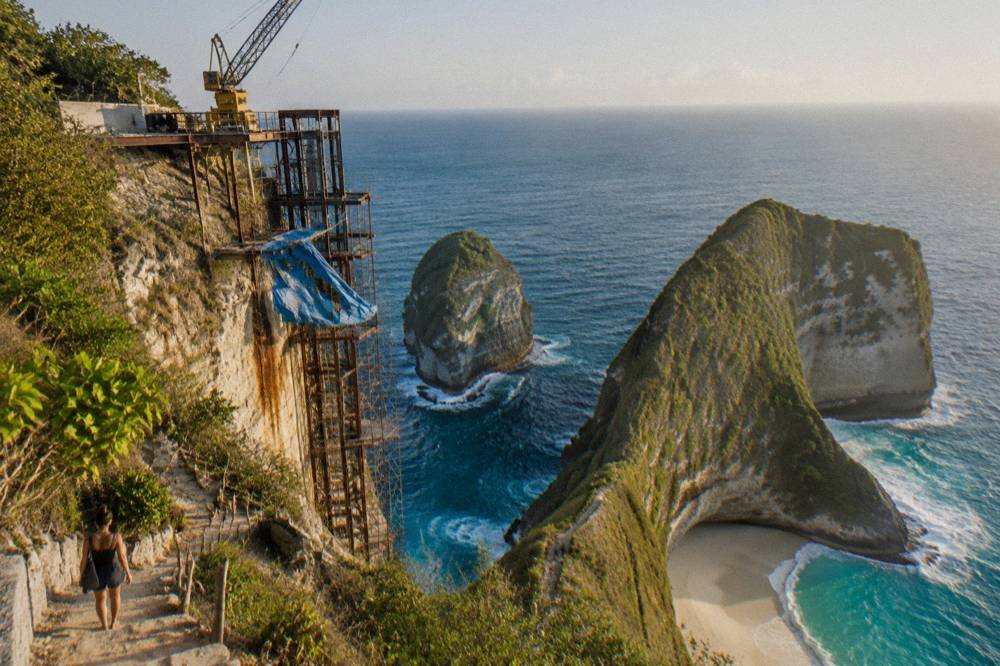
No tour on this roster, and no operator on the island, sells or promises the lift, and any listing or social post that does should be treated as false. The practical takeaway is simple: the descent remains the trail, the trail remains steep, and the stairs guide remains the page with the full logistics.
Should You Build A Whole Day Around Kelingking?
For most visitors, no: Kelingking works best as the anchor stop of a west coast day that also takes in Broken Beach and Angel's Billabong, which sit 20 to 40 minutes onward and complete the same loop. Only two groups benefit from a Kelingking-only day, serious photographers chasing specific light, and visitors attempting the full descent, which eats two to three hours on its own.
The west coast is a natural circuit, and the driving times make the case: from Kelingking, Broken Beach is about 20 to 30 minutes, Angel's Billabong sits beside it, and Crystal Bay is roughly 40 minutes from the Toyapakeh side. A tour that hits Kelingking alone spends most of its day on roads. That is why every west format on the roster bundles the cluster, and why the west coast tour guide compares the full set of options side by side.
For photographers, the case for a dedicated day is real but narrow. The best light on the headland comes in the late afternoon, after the tour groups have gone, and a private car with driver, from $27 per person on the Trip Gotik listing with a 4.8 rating from 2,740 reviews, lets you hold the platform until the sun drops and skip the midday crush entirely. For descent-makers, the arithmetic is starker: the trail round trip plus recovery time consumes most of a loose afternoon, so either book a private format or stay on the island overnight, options the where to stay guide covers.
For everyone else, the bundled west day is the stronger buy. It converts the same boat ticket and the same driver hours into three cliff stops and, on the snorkeling formats, a swim at Crystal Bay, which the swim ban makes the only water on the west loop.
Kelingking Compared With The Other Famous Nusa Penida Stops
Kelingking, Diamond Beach and Broken Beach divide the island's photography traffic between them: Kelingking is the viewpoint icon with a banned-swim cove, Diamond Beach is the east coast's steep-staircase beach with its own swimming prohibition, and Broken Beach is a natural arch you view from above with no water access at all. All three are reachable in one long day, but two days is the realistic version. If you want the full picture on that east coast stop, our guide to Diamond Beach and the Atuh viewpoint hike covers the stairs, the tides, and what the swim ban actually means.
Travellers planning a first visit almost always try to stack all three, so the comparison matters. The honest summary: Kelingking has the most famous shape and the hardest trail, Diamond Beach has the most beautiful sand and a carved staircase that is easier than Kelingking's trail but still serious, and Broken Beach is the least demanding, a short flat walk to an arch viewpoint, with Angel's Billabong beside it. The Diamond Beach guide covers the east coast stop in full, and the east coast tour guide covers how the tours sequence it.
| Stop | Coast | Effort at the top stop | Water access | Signature view |
|---|---|---|---|---|
| Kelingking Beach | West | Flat viewpoint; steep optional trail | Swimming banned | T-Rex headland and cove |
| Diamond Beach | East | Carved cliff staircase to the sand | Swimming prohibited | White sand below vertical cliffs |
| Broken Beach | West | Short flat walk | None, viewpoint only | Natural rock arch and lagoon |
| Angel's Billabong | West | Short walk over rock | Swimming banned since 2023 | Tidal rock pool formation |
| Crystal Bay | West | Short walk from parking | Swimming and snorkeling allowed | Sheltered bay, reef, sunfish season |
Stacking all three in a single day is what the east-plus-west tours sell, and the Trip Gotik East and West Highlights format, from $33 per person with a 4.7 rating from 8,370 reviews, does exactly that inside 8 to 10 hours. It works, but it is a photo day, with viewpoint time at each stop and no room for a Kelingking descent. Two days, or one west day done properly, serves the island better.
Whichever way you go, the booking mechanics stay simple. Every listing on this roster carries free cancellation, so a date can be locked in early and shifted if the weather forecast turns or the ferry schedule changes. Compare the three west-focused options below against the all-inclusive transfers format above, and pick on time-at-Kelingking rather than headline price, since the difference between a 30 minute stop and a 90 minute one is the difference between seeing the cliff and experiencing it.
Common Questions About Kelingking Beach
Is Kelingking Beach free to enter?
Yes. There is no entrance fee at Kelingking itself; you pay only parking, about IDR 5,000 for a scooter and IDR 10,000 for a car, plus the island retribution of IDR 25,000 per adult, which is scanned at the harbour and covers Broken Beach and Angel's Billabong the same day.
Can you swim at Kelingking Beach?
No. Swimming has been banned since February 2023 because of dangerous currents, a heavy shore break and the absence of lifeguards. The beach at the bottom of the trail is for standing and photos only.
How long does the descent to Kelingking Beach take?
Most accounts put the descent at about 20 to 45 minutes and the ascent at 45 to 90 minutes or more depending on fitness and heat. The trail has built steps at the top and loose rock with crude railings below. The full logistics are in the dedicated stairs guide.
How far is Kelingking Beach from the harbour?
About 30 to 60 minutes by road from the Toyapakeh and Banjar Nyuh harbour area, depending on traffic. From Sanur in Bali, add a fast boat crossing of roughly 25 to 60 minutes.
Is the glass lift at Kelingking open?
No. Construction was halted on 31 October 2025, the investor won an administrative court case on 3 September 2026, and the province is appealing. No work has restarted, there is no opening date, and access to the beach remains on foot only.
Do tours include time to go down to the beach?
Most group west tours allow about 30 to 60 minutes at Kelingking, which covers the viewpoint but not the descent. If the beach is your goal, book a private format or a private car with driver, and plan the stop for two to three hours.