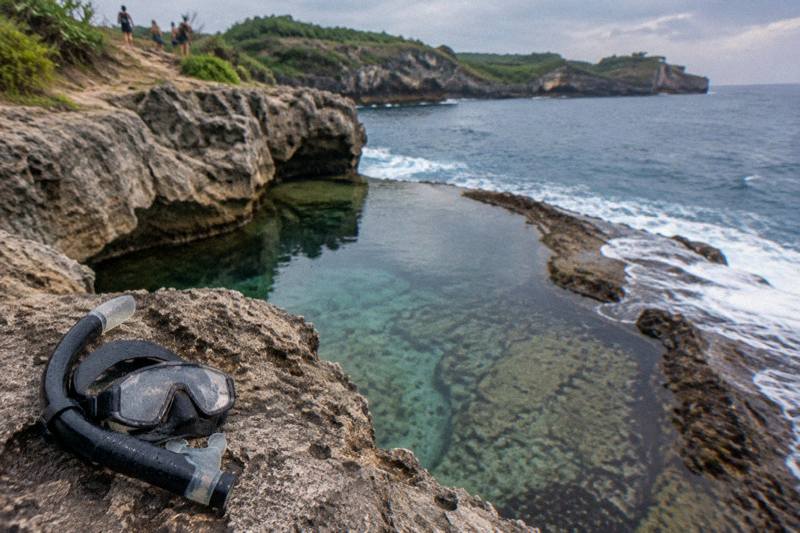
Is It Safe To Swim At Kelingking Beach?
No. Swimming at Kelingking Beach has been banned since February 2023, and for good reason: strong currents, a violent shore break and no lifeguards. Here is what that means for your Nusa Penida day trip, and where to swim instead.
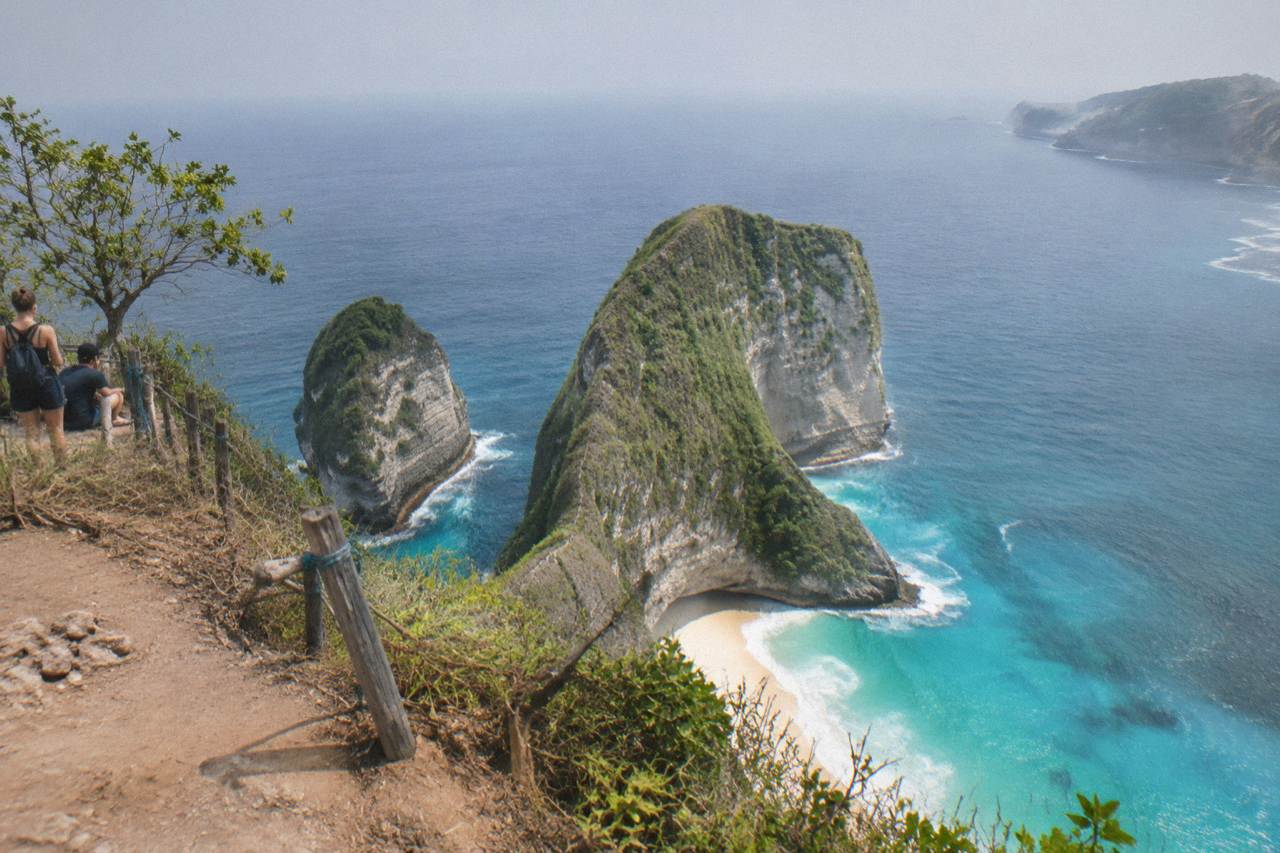
The photograph everyone wants from Nusa Penida is the T-Rex cliff at Kelingking, shot from the viewpoint with the beach curving away below. What the photograph does not show is the surf line at the base of that cliff, which is where the island's most dangerous water sits. This article answers the question directly, explains the ban, and maps out where swimmers and snorkelers actually go on a Nusa Penida day, from sheltered Crystal Bay to guided manta stops further along the west coast.
Is It Safe To Swim At Kelingking Beach?
No, and it is not a matter of personal judgement. Swimming at Kelingking Beach has been officially banned since February 2023, and the local guidance is unambiguous. The beach sits under a cliff at the end of a steep trail, the water is shaped by strong currents and a heavy shore break, and there are no lifeguards. Visitors can walk the trail and stand on the sand, but the sea there is closed to swimmers.
The ban is not paperwork that nobody enforces. It followed drownings at this stretch of coast, and the local site guide for Kelingking states it plainly alongside the other access rules for the trail. The same page documents the descent itself: a stepped upper section giving way to rock and a low bamboo handrail, about 20 minutes down and much slower coming back up. You can read the full trail picture in the guide to Kelingking stairs and the halted lift.
What trips people up is that the water looks inviting. From the viewpoint, Kelingking reads as a calm tropical bay, turquoise and glassy in the midday light. That appearance is a trick of scale. The cliff is enormous, the beach is small, and the swell that rolls in from the Indian Ocean side of the island hits a steeply shelving sand floor. The result is a shore break that goes from knee-deep to over your head in a single wave, with a current running along the base of the cliff that pulls sideways, not out, which is harder to read from the sand.
For practical purposes, the question is not whether you are a strong swimmer. The question is what your day looks like if the island's headline beach is off-limits for swimming, and the honest answer is that it barely matters, because almost every Nusa Penida day trip from Bali treats Kelingking as a viewpoint stop and puts the water time somewhere safer.
The three tours above are the formats that handle this best: a west coast tour with boat snorkeling built in, a pure land tour of the west side, and a manta snorkel trip that adds the west coast by car. All three visit Kelingking as a viewpoint stop and none of them asks you to swim there.
Why Can't You Swim At Kelingking Beach?
The ban exists because the water at Kelingking combines three hazards that do not cancel each other out. Strong longshore and rip currents run along the base of the cliff, the shore break is heavy onto a steep sand shelf, and there is no lifeguard service or rescue infrastructure anywhere on the beach. Drownings occurred here before the ban, and the local authority closed the water to swimmers in February 2023.
Breaking that down: the current is the hidden one. Swimmers who get into trouble at Kelingking are usually moved sideways along the cliff before they realise they are being moved at all, and the natural instinct, swimming back to the spot of sand they left, fights the water instead of exiting it. The shore break is the visible one, and it is what catches people who only wade. A wave that breaks in waist-deep water onto a steep shelf can knock an adult flat, and the next wave arrives before the first one has drained.
The third factor is the one that turns a difficult situation into a fatal one. There is no lifeguard tower, no rescue board, no flagged swimming zone. The trail down takes about 20 minutes for an able adult, so even a bystander calling for help means a long delay before anyone with equipment reaches the water. The local guide's page on Kelingking Beach documents the trail, the ban and the viewpoint in detail, and it is the clearest single reference on the site's rules.
One thing the ban is not: it is not a seasonal closure or a temporary measure that lapses in the dry season. It has been in force since February 2023 and applies year-round, including on the flat, calm mornings when the bay looks its most harmless. If a tour operator or driver tells you the water is fine today, they are guessing, and the official position says otherwise.
If your heart was set on water time on the west side, the fix is simple: book a tour that includes a snorkel stop by boat. The Check availability link sits beside the full write-up of the One Day Nusa Penida Island West with Snorkeling tour, which covers exactly this.
Can You Still Walk Down The Kelingking Stairs?
Yes, the trail to the beach itself remains open, and it is on foot only. The upper section has built steps, the lower section is rock and dirt with a low bamboo handrail, and the descent takes about 20 minutes for a fit adult with the return climb taking considerably longer. No lift or elevator exists at Kelingking: a glass lift project was halted in October 2025 and no work has restarted.
The lift deserves a sentence because it keeps resurfacing in travel forums. Construction was halted by the Bali authorities in October 2025 over planning, environmental and safety breaches, an investor won an administrative court case in September 2026, the province is appealing, and the unfinished structure just sits there. There is no opening date and no ticket, and the trail remains the only way down. Anyone selling you a "Kelingking elevator experience" is selling something that does not exist.
On the trail itself, the honest advice is that the descent is optional and the viewpoint is the main event. The viewpoint platform at the top is free to stand at, delivers the famous photograph, and involves no exposure at all. The trail adds real exercise, loose rock and heat, and the payoff at the bottom is a beach you can stand on but cannot swim at. Many visitors on a tight Nusa Penida itinerary skip the descent entirely and lose nothing from the day.
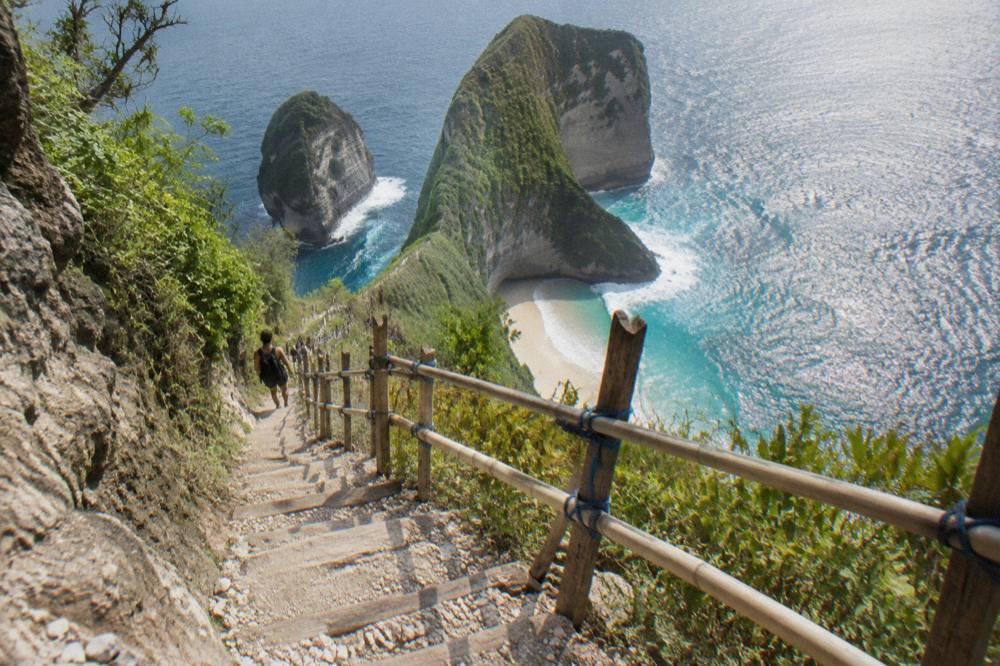
If you do go down, treat the climb back as the hard part. Reports from the trail put the ascent at anywhere from 45 minutes to well over an hour depending on fitness and heat, against roughly 20 minutes down. Carry more water than feels reasonable, wear shoes with grip rather than flip-flops, and do not attempt it in the midday sun on a day when your boat back to Bali leaves in the afternoon. The swim ban at the bottom is the last of the trail's decisions, not the first.
Which Beach On Nusa Penida Is Best For Swimming?
Crystal Bay is the island's best swimming beach, and it is not close. The bay is sheltered from the open-ocean swell, the visibility in good conditions runs 20 to 30 metres, the water is calmest from April to September, and tour boats use it as a standard snorkel stop. Gamat Bay is the quieter alternative, sheltered and suitable year-round, with fewer boats and fewer people.
The contrast with Kelingking is structural, not just a matter of local preference. Crystal Bay faces west into water that the headlands buffer, so the swell arrives tired. Kelingking faces open ocean with a cliff at its back. The same logic explains why every snorkeling operator on the island routes to Crystal Bay and Gamat Bay and treats the Kelingking water as a no-go, a pattern you can see across every product in the Nusa Penida snorkeling tours roundup.
| Beach or bay | Swimming status | Why | Best conditions |
|---|---|---|---|
| Kelingking Beach | Banned since February 2023 | Strong currents, heavy shore break, no lifeguards | Viewpoint only, any season |
| Diamond Beach | Swimming prohibited | Strong waves and rip currents, steep cliff access | Viewpoint and staircase only |
| Angel's Billabong | Swimming prohibited after a fatal accident | Waves surge through the rock pool at high tide | Low-tide viewing only |
| Broken Beach | No water access at all | The arch is a viewpoint; there is no beach entry | Viewpoint only |
| Crystal Bay | Open, sheltered | Buffered swell, 20 to 30 m visibility | Calmest April to September |
| Gamat Bay | Open, sheltered, quiet | Mild currents, healthy coral, fewer boats | Suitable year-round |
The banned rows matter as much as the open ones. Diamond Beach, the east coast's headline spot, prohibits swimming for the same reasons as Kelingking, and Angel's Billabong, the natural rock pool next to Broken Beach, closed its water after a fatal accident in February 2023. Visitors sometimes assume the Billabong pool is an exception because it looks like a swimming pool; it is not, and the surge at high tide is exactly what makes it dangerous. The pattern is consistent: on Nusa Penida, the dramatic geology and the swimmable water are in different places, and the tours are built around that fact. Since the viewpoint alone gives you the famous photo, our guide to whether the Kelingking descent is worth the climb helps you decide if the scramble down fits your day.
Where Can You Safely Snorkel Instead Of Swimming At Kelingking?
The safe water on Nusa Penida is reached by boat or at sheltered bays, not off the big-name beaches. Crystal Bay and Gamat Bay hold calm water and coral, the manta sites of Manta Bay and Manta Point are run as guided snorkel stops with supervision, and the protected-area rules require a minimum 3 metre distance from the animals. Boat-based snorkel stops are the standard fix for the Kelingking swim ban.
The guided format is the key point. Snorkeling on Nusa Penida is not a free-swim activity at most sites; it is a supervised one, with a boat, a guide in the water and a defined area. The manta code of conduct, set out by local operators and conservation groups, requires snorkelers to stay at least 3 metres from the rays, never touch or chase them, and keep out of the cleaning stations. The code of conduct is published by local dive and snorkel operators and is worth reading before any trip.
Manta sightings run year-round here, with no migration season, because the animals live around the cleaning stations and follow the plankton. Operator-reported sighting rates run about 85 to 95 percent at Manta Point and 60 to 85 percent at Manta Bay, and those are operator-reported numbers, not guarantees. No tour on this roster promises a sighting, and the dry season from April to October brings calmer seas and visibility of 15 to 30 metres, while the wet season from November to March brings rougher swell and lower visibility. The month-by-month picture is in the guide to Nusa Penida manta point snorkeling.
The One Day Nusa Penida Island West with Snorkeling tour is the natural fit for a visitor whose plan was "Kelingking, then a swim". It runs the west coast land loop, Kelingking, Broken Beach, Angel's Billabong, then puts you on a snorkel boat for the water part of the day, rated 4.5 from 597 reviews and from $66.96 with free cancellation. The swim ban at Kelingking simply never comes up, because the swimming happens where the water is actually safe.
Do Manta Snorkel Stops Replace The Beach Swim?
For most visitors, yes, and often they exceed it. A manta snorkel stop delivers the one thing no beach on Nusa Penida can: a reliable encounter with large marine life in open water, under supervision, with gear and a guide included. Reef manta rays are present year-round, the stops are run as guided sessions, and the tour formats bundle them with the west coast viewpoints so nothing from the classic day trip is lost.
The formats vary enough to matter. Shared boat tours keep the price down and suit solo travellers and pairs. Private snorkel boats cost more and give you the water to yourself, with the operator's own guide in the water the whole time. The private boat option from Nice Trip Nusa Penida, rated 4.6 from 516 reviews and from $65 per person, runs three to four hours with a private boat, full gear and a GoPro in the water, which is the kind of session that turns a banned beach swim into the best hour of the trip.
The depth of the water is worth knowing before you book. Manta Bay is the shallower, more sheltered of the two manta sites and the one most snorkelers are taken to; Manta Point is deeper and more exposed, and it is where the diving boats go. In the wet season, operators reroute or cancel Manta Point sessions when the swell is up, which is a normal, honest outcome, and the calmer bay is the fallback. Water temperatures run 22 to 29 degrees across the year, with cooler thermoclines in the dry season, so a rash vest is not a bad idea even in July.
What Fees Apply When You Visit Kelingking Beach?
There is no entrance fee at Kelingking itself, only parking: about IDR 5,000 for a scooter and IDR 10,000 for a car. The island retribution is a separate official charge of IDR 25,000 per adult and IDR 15,000 per child aged 4 to 13, paid via a QR voucher at the harbour, and one voucher covers Kelingking, Broken Beach and Angel's Billabong the same day.
The retribution is the one that catches day-trippers by surprise, because it is collected at the harbour on arrival rather than at any attraction gate. The official retribution portal publishes the amounts and the voucher system, and the legal basis is Klungkung Regency Regulation No. 8 of 2023. It applies to all visitors, domestic and foreign, and it is separate from the Bali-wide tourist levy of IDR 150,000 that foreign visitors pay once per trip before they travel, at the official Love Bali portal or at airport and port counters.
The practical shortcut is that many tours absorb this entirely. Listings on this roster routinely include entrance fees to the named attractions in the ticket price, which removes the queue at the harbour counter and the small queue at each viewpoint. The full breakdown of what is and is not included across the island's charges is in the guide to the Nusa Penida entrance fee and the Bali tourist levy, and it is worth checking your tour's inclusions against that list before you assume you owe anything at the gate.
| Charge | Amount | Who pays | Where it is paid |
|---|---|---|---|
| Kelingking parking | IDR 5,000 scooter, IDR 10,000 car | Everyone arriving by vehicle | On site |
| Island retribution | IDR 25,000 adult, IDR 15,000 child 4-13 | All visitors | Online or at the harbour, QR voucher |
| Bali tourist levy | IDR 150,000 once per trip | Foreign tourists | Online before travel, or on-arrival counters |
| Goa Giri Putri entry | IDR 50,000 per person | Visitors to the cave temple | On site, sarong required |
One caution: per-attraction fees beyond the official island retribution are not something to prepay or budget as fixed numbers. Reports of separate per-site charges circulate, but the official portal describes a single voucher covering the main west coast sites the same day, so treat any extra per-site fee as unconfirmed and check what your tour price already includes.
Which Tours Cover Kelingking Without A Swim?
Almost every land tour on the island does, because the standard west coast route treats Kelingking, Broken Beach and Angel's Billabong as viewpoint stops with no water access at any of them. A west-only land tour, a combined east and west tour from $33, or a manta snorkel trip that adds the west coast by car all deliver the Kelingking photograph without ever putting you in banned water.
The west-only format deserves more attention than it gets. Most first-time visitors default to the combined east and west day, which is a long day, roughly eight to ten hours, spent mostly in a vehicle. A west-only tour spends less time driving and more time at the three viewpoints, and for a traveller whose priority is the Kelingking cliff rather than Diamond Beach, it is the better-shaped day. The comparison is laid out in the guide to the Nusa Penida west tour. If you're still weighing which shoreline deserves your limited hours, the full comparison of Diamond Beach versus Kelingking Beach settles the question of stairs, crowds and swimming rules.
The manta-plus-land format is the strongest answer to this article's question. It takes the swim ban as a design constraint rather than a disappointment: you get the viewpoints in a private car, then a boat takes you to the water that is actually open, with gear and a guide included. The Manta Point Snorkeling and West Coast Tour, rated 4.6 from 1,674 reviews and from $28 per person, is the budget version of that idea, and it is one of the cheapest ways on the roster to get both halves of the island in one booking.
Timing shapes all of these. The viewpoints are best before mid-morning, both for light and for crowd levels, and July and August are the busiest months on the island. A tour that starts early from Sanur, on one of the 20-plus daily fast boat departures that run from early morning until about 17:00, beats the crowds to the cliff and still leaves the afternoon for the water. The logistics of the crossing are covered in the guide to the fast boat to Nusa Penida.
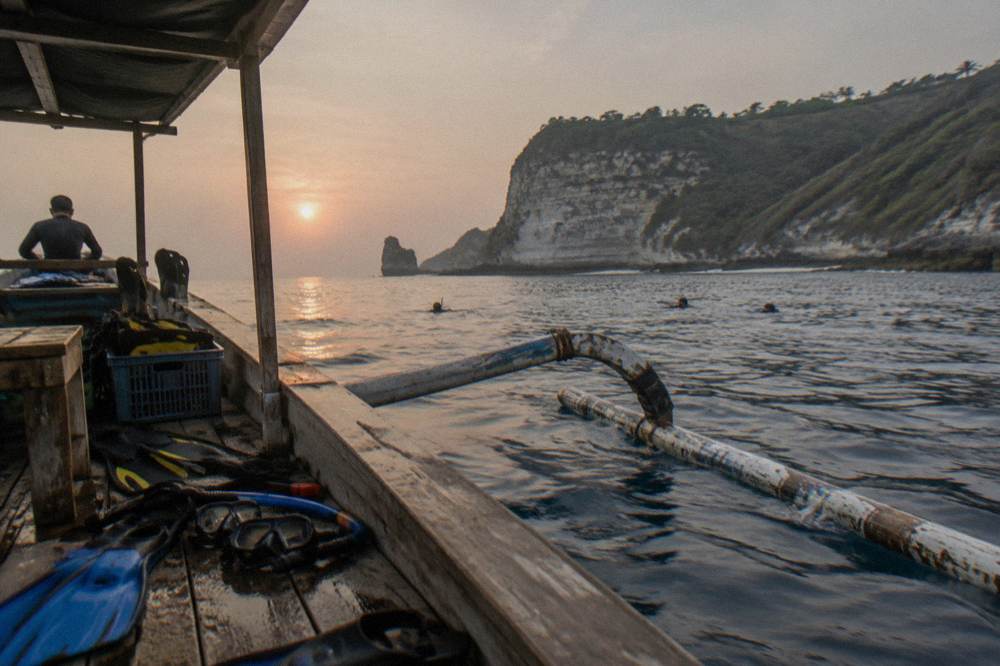
The honest summary for anyone planning around the swim ban: the water you saw in the Kelingking photograph is not the water you swim in on Nusa Penida, and the tours that accept this are the ones that deliver the better day. The site's Nusa Penida Tours roster is built around exactly that split, viewpoint stops on the cliffs, water time in the sheltered bays and manta sites, and every product on it respects the ban.
Common Questions About Swimming On Nusa Penida
Is It Safe To Swim At Kelingking Beach?
No. Swimming has been banned at Kelingking Beach since February 2023 because of strong currents, a heavy shore break and the absence of lifeguards. The trail to the beach remains open on foot, but the water is closed to swimmers year-round.
Why Can't You Swim At Kelingking Beach?
Three combined hazards: longshore and rip currents along the base of the cliff, a heavy shore break onto a steep sand shelf, and no lifeguard or rescue service. Drownings occurred before the ban, and the local authority closed the water in February 2023.
Which Beach On Nusa Penida Is Best For Swimming?
Crystal Bay. It is sheltered by headlands, visibility runs 20 to 30 metres in good conditions, and it is calmest from April to September. Gamat Bay is the quieter sheltered alternative and is suitable year-round.
Can You Walk Down To Kelingking Beach Itself?
Yes. The trail is open and on foot only, with built steps at the top and rock with a bamboo handrail below. The descent takes about 20 minutes and the climb back considerably longer. There is no lift: the glass elevator project was halted in October 2025 and no work has restarted.
Is Angel's Billabong Safe To Swim In?
No. Swimming at Angel's Billabong has been prohibited since a fatal accident in February 2023. The rock pool looks calm but waves surge through it at high tide; it is a low-tide viewing spot only.
Do Nusa Penida Tours Include Safe Swimming Time?
Many do, in the form of guided snorkel stops rather than beach free-swims. Tours that pair the west coast viewpoints with boat snorkeling, such as the One Day Nusa Penida Island West with Snorkeling tour, put the water time at the sheltered bays and manta sites where conditions are supervised.