Is It Worth Going Down To Kelingking Beach?
The honest time maths for the Kelingking Beach descent on Nusa Penida: about 20 minutes down, much slower back up, no swimming at the bottom, and when the viewpoint alone is the better call.
Is It Worth Going Down To Kelingking Beach?
For most visitors on a normal tour day, no: the viewpoint gives you the famous T-Rex cliff photo and the panoramas, while the beach below adds a steep descent of about 20 minutes and a much slower climb back up, all for sand and a shoreline you cannot swim from. It is worth it only if you have spare time, decent shoes and steady legs, and you accept the climb as the experience itself.
That is the short version, and it is deliberately blunt. Kelingking Beach is the single most photographed spot on Nusa Penida, and almost every one of those photos is taken from the top, not the bottom. The viewpoint and the cliff trail above it cost nothing but the walk from the parking area. The beach costs real effort, real time, and, for anyone with knee trouble, vertigo or a tight tour schedule, a genuine risk of wrecking the rest of the day. If you're weighing whether the climb is even the right pick, our comparison of Diamond Beach versus Kelingking Beach settles which one deserves your limited time on Nusa Penida.
The question matters because of how tour days on Nusa Penida are built. The island is about 200 square kilometres with no public transport, and the standard west-coast circuit, Kelingking, Broken Beach, Angel's Billabong and often Crystal Bay, is usually sold as a single packed day. Operators like Smile Nusa Penida run that circuit from about $35.5 per person, and the schedule assumes you spend 30 to 45 minutes at Kelingking, not two hours. Every extra hour at the cliff is an hour taken from somewhere else. That trade-off between time at the cliff and the rest of the circuit is exactly why many travellers ask whether a one-day Nusa Penida itinerary is realistic at all.
This article walks the decision the way you would actually make it on the day: what the climb really takes, what the bottom delivers, what the top already gives you, and how to keep one ambitious detour from eating a whole itinerary. The short answer for most readers of Nusa Penida Tours is that the descent is a worthwhile add-on for the fit and the free-scheduled, and a skip for everyone else, and both choices are completely defensible.
Is Kelingking Beach Worth Visiting?
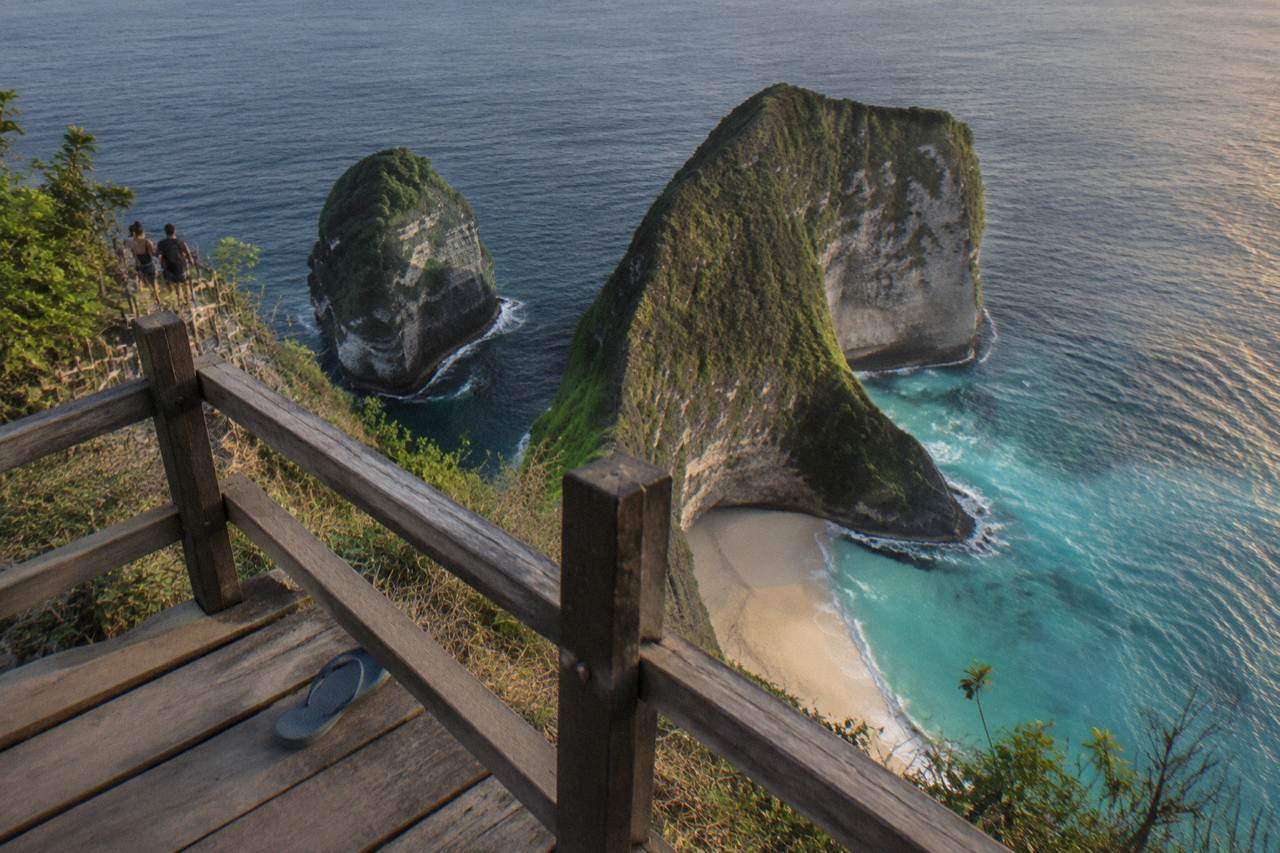
Yes, unconditionally, and that answer does not depend on going down. The cliff itself, a limestone headland shaped like a Tyrannosaurus profile above a white-sand cove, is one of the most striking coastal landforms in Indonesia, and the viewpoint above it delivers the full spectacle in about five minutes of easy walking from the parking area. Kelingking belongs on any west-coast day regardless of whether you ever touch the sand.
The distinction that trips people up is between the place and the beach. The place is worth visiting for everyone. The beach, the strip of sand at the bottom of the cliff, is worth visiting for a much smaller group, and the gap between those two answers is the whole subject of this article.
Access logistics are simple. There is no entrance fee at Kelingking; parking runs about IDR 5,000 for a scooter and IDR 10,000 for a car. What every visitor does pay is the Nusa Penida island retribution, IDR 25,000 per adult and IDR 15,000 for children aged 4 to 13, collected on arrival at the harbour as a QR voucher. One voucher covers Kelingking, Broken Beach and Angel's Billabong on the same day with no re-payment, which is worth knowing before you budget a west-coast circuit. The official portal at nusapenidaretribusi.com spells out the amounts and the single-voucher rule.
The road to get there has also improved. A roughly 2 km access-road upgrade toward Kelingking began in July 2026, hotmix asphalt and concrete shoulders, and the main loop roads are in markedly better condition than a few years ago. The side routes remain narrow and hilly in places, which is one reason the west-coast tour guide recommends a driver over a scooter for first-time visitors.
Is It Hard To Get To Kelingking Beach?
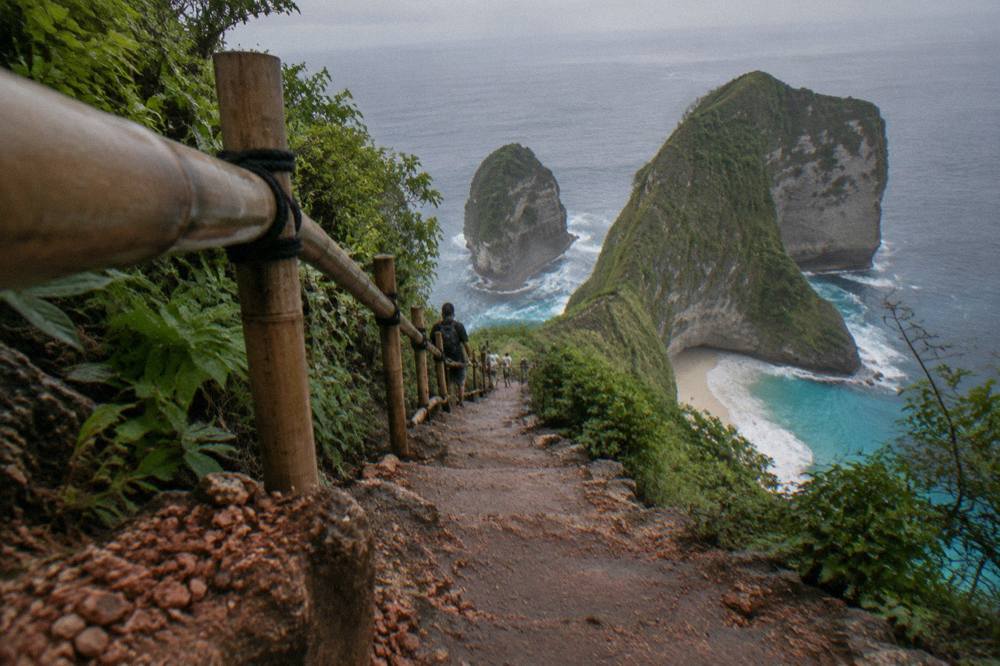
Getting to the top of Kelingking is easy: a paved road from Toyapakeh in about 30 to 60 minutes, a short walk from the parking area, and you are standing at the viewpoint. Getting to the beach is the hard part, because the only access is on foot down a steep cliff trail with loose rock, gravel and crude bamboo-and-rope railings, roughly 20 minutes down and considerably longer back up.
The trail is not a staircase the whole way. The upper section has built steps; below that it becomes rock, dirt and uneven sections where the handrail is a low bamboo line you will want to test before trusting. Local reporting and the detailed trail description at nusapenida.org both describe the same thing: a steep descent where the way back up takes far longer than the way down, with reported ascent times ranging from 45 minutes to well over an hour depending on fitness, heat and crowding.
| Leg of the trip | Typical time | Notes |
|---|---|---|
| Toyapakeh harbour to Kelingking parking | 30 to 60 minutes by car | Mainly paved; road upgrade underway since July 2026 |
| Parking to viewpoint | About 5 minutes | Flat, safe for almost everyone |
| Viewpoint to the beach | About 20 minutes down | Steep, loose rock, crude railings |
| Beach back up to the viewpoint | 45 to 90+ minutes | Depends on fitness, heat and crowds; much slower than the descent |
Two things make the climb harder than the raw numbers suggest. The first is heat: there is no shade on the trail, and the middle of a Nusa Penida day is brutal on exposed limestone. The second is crowding: the trail is single-file in places, and in the July-August peak you can spend stretches of the ascent standing still on a 40-degree slope behind someone else's recovery break.
The structure on the cliff that sometimes appears in photos, the unfinished lift project, is not an access option. Construction was halted in October 2025 over planning, environmental and safety breaches; an investor won an administrative court case in September 2026, the province is appealing, no work has restarted, and there is no opening date. Access is on foot, full stop. The stairs and lift explainer covers that saga in detail.
How Long Does The Climb Down And Back Up Really Take?
Budget two hours total for the descent and the return, not the 40 minutes a naive reading of "20 minutes down" suggests. Local reports put the ascent at 45 to 90 minutes or more, and that is before you add time at the bottom, photos, and the recovery break you will want at the top. Anyone planning a packed west-coast circuit should treat the beach as a two-hour line item or skip it.
The asymmetry is the part people underestimate. Gravity helps you down; on the way back it is you against the slope, in the sun, on loose ground, likely in trainers rather than hiking shoes. Reports from hikers consistently describe the ascent as the hardest 45 to 90 minutes of their Nusa Penida trip, and the descent as the more dangerous half, because the loose rock punishes hurry more than fatigue does.
The honest budget for a beach visit looks like this: 20 minutes down, 15 to 30 minutes on the sand, and 45 to 90 minutes back up, plus water and a rest at the top. Call it 90 minutes on a good day for a fit pair, two hours or more for most people. Against a tour schedule that gives Kelingking a 30 to 45 minute stop, that is the entire margin of the day.
This is where the private-tour format earns its price. The West Nusa Penida Kelingking Broken Beach Private Guided Tour from Seminyak Tour Driver Bali, rated 4.7 from 57 reviews, runs from $39.51 per person for about 9 to 10 hours with a private car and an English-speaking guide-driver, and private itineraries flex around a long climb in a way shared schedules cannot.
If you are on a shared circuit and the guide gives the group 45 minutes, the descent is effectively closed to you: you cannot do it safely in that window, and guides will tell you so. That is not the guide being difficult, it is arithmetic.
What Do You Actually Get At The Bottom?
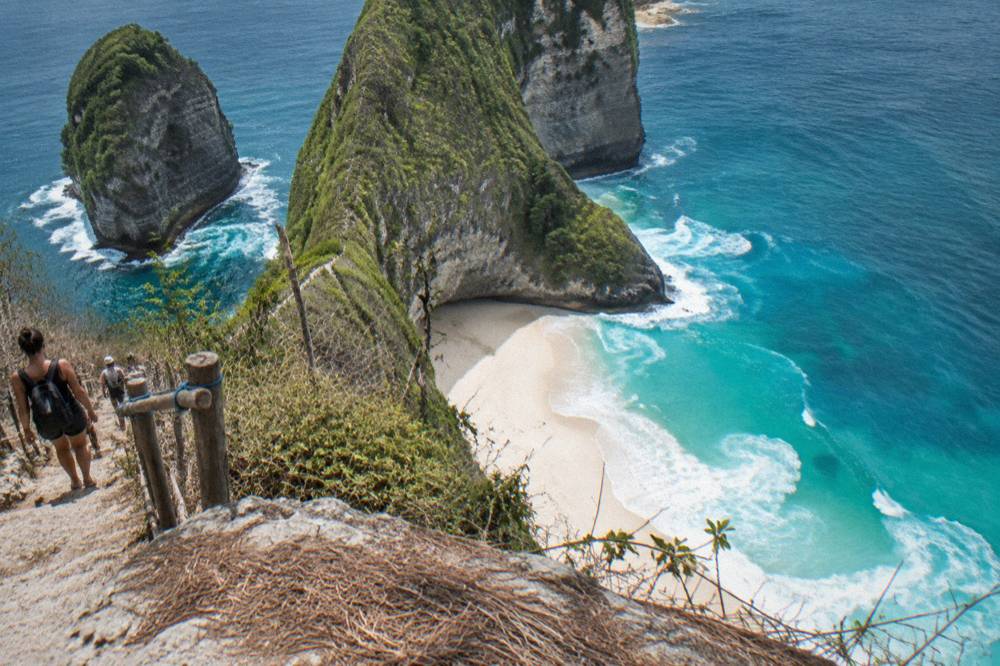
You get a real beach: a strip of white sand at the base of the cliff, close-up views of the rock formations, and a shoreline that is genuinely spectacular to stand on. What you do not get is swimming, which has been banned at Kelingking since February 2023 because of dangerous currents and a heavy shore break, and there are no lifeguards, no facilities and no shade at the bottom. If you're wondering why the ban exists and where you can actually swim on Nusa Penida instead, our full guide to swimming safety at Kelingking Beach covers the currents, the shore break, and the better alternatives nearby.
The swimming ban is the fact that changes the value calculation most, and it is enforced seriously: people have drowned at Kelingking, and the safety answer for Kelingking swimming is a flat no in all seasons. So the bottom delivers sand, photographs from an angle almost nobody has, and the strange experience of standing under the cliff whose silhouette you have seen on a thousand screensavers.
What it does not deliver is relief from the heat. There is no shade, no vendor, no water source and no toilet at the beach. Whatever you carry down, you carry back up, and every extra bottle is weight on the climb. Most experienced visitors carry one litre per person, wear real shoes, and leave everything else at the top with a member of their party who is not climbing.
The photographic case for the bottom is real but narrower than people expect. From the sand, you lose the T-Rex profile entirely, because you are standing inside it. The best photos of the beach itself are actually taken from the trail halfway down, where the cove, the cliff and the water all fit in one frame. That is worth knowing, because it means a partial descent, going 10 minutes down to the first clear vantage and then turning around, captures most of the unique photographic value at a fraction of the cost.
The final honest line on the bottom: it is a place you visit for the experience of having been there, not for anything you can do there. If that sentence sounds like your kind of travel, go down. If it sounds like a lot of climbing for a view you cannot swim in, the viewpoint was built for you.
What Does The Viewpoint Give You Without The Descent?
Almost everything, for almost no effort. The viewpoint delivers the full T-Rex cliff profile, the cove, the turquoise water and the sweep of the Nusa Penida coastline, from a platform about five minutes of flat walking from the parking area, with railings at the main platforms and no time limit beyond your tour's schedule. The famous photo is taken here, not from the sand.
This is the part of the decision that deserves emphasis, because the marketing of Nusa Penida makes it sound like the beach is the destination and the viewpoint a preview. It is the other way round. The image that made Kelingking famous, the headland that gave the island its global profile, is a viewpoint shot. Almost every photo you have ever seen of Kelingking was taken from where the car parks.
The viewpoint area also has the practical advantages: vendors for water and coconuts, shade structures in places, toilets near the parking area, and a series of small cliff-edge outcrops and platforms that give different angles without any technical difficulty. You can spend a full 45 minutes working the angles at the top and come away with a more varied set of photos than a beach-goer who spent the same 45 minutes on a round trip to the bottom.
The safety margin is not trivial either. The cliff edges above the trail are unfenced in places beyond the main platforms, and the September 2026 fatality at Kelingking involved a visitor who left the marked path. The viewpoint platforms keep you on the marked, railed ground; the trail and the outcrops beyond it do not. Local coverage of the cliff, the fall and the halted lift at indoneo.com is sober reading for anyone tempted off-trail for a photo.
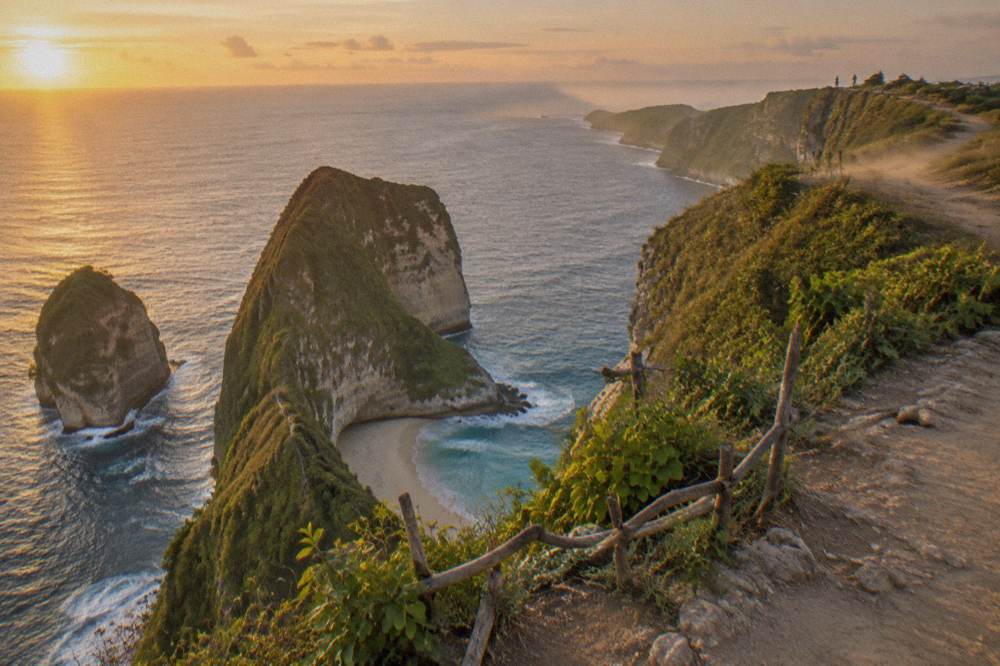
So the honest framing of the choice is not "viewpoint or miss out". It is "viewpoint, or viewpoint plus an adventure". The second option is better for some people. It is simply not better for everyone, and the tour-day arithmetic decides it more often than fitness does.
When Should You Skip The Descent Altogether?
Skip it if any of these apply: you are on a shared tour with a stop under about 90 minutes, the day is already hot by mid-morning, anyone in your party has knee, ankle or heart trouble, you are wearing sandals, or the trail is wet. Each of these turns a hard climb into a bad decision, and the viewpoint loses almost nothing by your skipping.
The schedule reason is the most common. Shared day tours, like the all-inclusive full-day option from Trip Gotik rated 4.6 from 2,310 reviews and running from $42 per person, move on a timetable. If the guide allots 45 minutes at Kelingking, the descent is not possible, and attempting a rushed version of it is exactly how accidents happen on loose rock. The correct move is to say so at the start of the day and plan a return trip, or book a private format that can absorb the time.
The heat reason is next. There is no shade on the trail and the rock radiates. A 10:30 arrival in dry season means climbing back up in the strongest sun of the day. If your driver can get you to Kelingking before 09:00, the descent is a different proposition entirely, cool air, empty trail, better photos, and this is the single best argument for paying for a private driver: control of the clock.
The physical reasons need no elaboration beyond this: the ascent is a sustained steep cardio climb on uneven ground, and the descent is hard on knees and ankles. Neither is extreme. Both are unforgiving of poor footwear, and sandals on that trail are a sprained ankle waiting for a place to happen.
The wet reason is absolute. After rain the trail's loose rock becomes slick, and the bamboo railings help with balance, not with grip. If it has rained in the last few hours, stay at the top, no exceptions, and the weather and best-time guide helps you judge which months make this a live risk.
How Do You Protect The Rest Of A Tour Day?
Treat the descent as a scheduled line item with a two-hour cost, and build the rest of the day around it: pick a private format or a small-group tour, front-load Kelingking before the heat, cut Crystal Bay snorkelling before you cut Broken Beach, and agree the day's timings with your driver in the morning rather than discovering them at the cliff.
The arithmetic of a west-coast day is tight. Toyapakeh to Kelingking is 30 to 60 minutes by car, Kelingking to Broken Beach another 20 to 30, and the last fast boats back to Sanur leave in the late afternoon. Add a two-hour beach detour to a schedule built for 45-minute stops and something gives, usually the last stop, sometimes the boat.
| Day format | Typical Kelingking stop | Can absorb the descent? | Best for |
|---|---|---|---|
| Shared group tour | 30 to 45 minutes | No | Lowest price, first-time overview |
| Private car with driver | Set by you | Yes, if the day is built around it | Photographers, confident walkers |
| Private guided tour | Flexible with guide | Yes, with local judgement on conditions | Families, first-time visitors |
| Independent scooter | Fully flexible | Yes, but the ride back is the risk | Experienced riders only |
The private formats are the natural fit. The One Day Nusa Penida Island West tour from Smile Nusa Penida, rated 4.7 from 197 reviews, runs from $35.5 per person for about 8 hours with a private car and driver and all entrance tickets, and a private car means the timetable is a negotiation, not a decree. The same logic applies to hiring a driver directly: island drivers run about IDR 600,000 to 800,000 per car for a full day, and the roster's own private car hire with driver option, rated 4.8 from 2,740 reviews, starts from $27 per person for 6 to 8 hours, which is often cheaper than the DIY total once you add fuel, parking and the fast boat.
If the descent is the priority, the sequence that protects the day is: Kelingking first, before 09:00 if possible, then Broken Beach and Angel's Billabong, which sit 20 to 30 minutes apart and share the same retribution voucher, then Crystal Bay last, where the snorkelling is the most droppable item in wet season anyway. The full itinerary guide builds this ordering out for one, two and three-day stays.
One last protective habit: agree with your driver, at the start, what time you must leave Kelingking to make the last boat, and work backwards. The descent is a decision with a deadline attached, and knowing the deadline is what makes it a safe decision rather than a rushed one.
Is It Worth Going To Kelingking Beach?
Yes, Kelingking is worth going to for every visitor to Nusa Penida, and it anchors almost every west-coast tour on the island for good reason. Whether it is worth going down to the beach is a separate and personal question with a two-hour cost, a real climb, and no swimming at the end, and the viewpoint alone justifies the trip for anyone who answers that second question with no.
The two questions get blurred, and the blurring produces bad decisions in both directions. People who would love the climb skip Kelingking entirely because they have heard it is dangerous, which confuses the trail with the place. People who should never attempt the trail go down because they have heard the beach is the real thing, which confuses a hard add-on with the main event.
The place deserves its fame. The headland is genuinely one of the great coastal landforms of Southeast Asia, the water colour is real and not a filter, and the road improvements of the last two years, the 2 km access upgrade and the wider island repaving, have made it reachable for ordinary visitors rather than only the determined. The detailed guide to Kelingking Beach itself covers the viewpoint, the trail and the photography angles in full.
The beach is a bonus track. It is a great bonus track for the fit and the unhurried, and a genuine experience, standing under the cliff is something the viewpoint cannot give you. But it is optional, the tour-day cost is the largest single time commitment on the west coast, and the honest answer for the majority of day-trippers is that the viewpoint, 45 unhurried minutes of it, is the right amount of Kelingking.
Common Questions About The Kelingking Descent
Is It Worth Going Down To Kelingking Beach?
For most day-trippers, no: the viewpoint delivers the famous cliff profile and the best photos for about five minutes of easy walking, while the beach costs roughly two hours of steep climbing round trip and you cannot swim at the bottom. It becomes worth it if you have a flexible private schedule, decent shoes, spare time and the fitness for a 45 to 90 minute ascent in full sun.
Is Kelingking Beach Worth Visiting?
Yes, unconditionally. The headland and viewpoint are among the most striking coastal sights in Indonesia, reachable by a short walk from the parking area, with no entrance fee beyond parking of about IDR 5,000 for a scooter or IDR 10,000 for a car. The island retribution of IDR 25,000 per adult is paid once at the harbour and covers the same-day west-coast sites.
Is It Hard To Get To Kelingking Beach?
The top is easy: a 30 to 60 minute drive from Toyapakeh on mostly paved roads, then about five minutes of flat walking. The beach is hard: the only access is a steep foot trail with loose rock and crude railings, about 20 minutes down and 45 to 90 minutes or more back up, in full sun with no shade, no water and no facilities at the bottom.
Is It Worth Going To Kelingking Beach?
Yes, the site anchors nearly every west-coast tour on Nusa Penida and the viewpoint alone justifies the trip. The separate question of descending to the sand is personal: it costs about two hours, rewards you with a close-up cove you cannot swim in, and is best done early, in real shoes, on a private or flexible schedule.
Can You Swim At Kelingking Beach Once You Are Down?
No. Swimming has been banned at Kelingking since February 2023 because of strong currents and a heavy shore break, and there are no lifeguards. The beach at the bottom is for standing, photos and the experience of being under the cliff, not for the water.
How Much Time Should I Budget For The Descent?
About 20 minutes down, 15 to 30 minutes at the bottom, and 45 to 90 minutes back up, plus water and a rest at the top: budget 90 minutes on a good day and two hours to be safe. If your tour gives Kelingking less than about 90 minutes, the descent is off the table and the viewpoint is the correct way to spend the stop.